
|
|
|
 |
02- Ingredients for the Mexican Pantry |
|
Print this Recipe
Authentic Mexican cooking starts with traditionally used ingredients. Of course, substitutions can be made or ingredients left out and the dishes will still be flavorful, but to enjoy food as it was intended to be eaten, try to use authentic ingredients. This is not a comprehensive list of Mexican ingredients but describes items commonly used in Mexican cooking and in this book. A few of the ingredients may be unfamiliar or difficult to find, but are worth seeking in order to capture the flavors of authentic dishes. For hard to find items, see INFORMATION AND SPECIAL TECHNIQUES: Mail-Order Sources.
Achiote:
Reddish-orange seed of the annato tree used to season and color foods. A seasoning paste is also made from the seeds. Achiote is used extensively in the Yucatán region. The seeds and prepared seasoning paste are available in Latin American markets and some supermarkets.
Allspice:
Aromatic spice that's used whole or ground to flavor many foods. Allspice trees grow mainly in the states of Tabasco, Veracruz, Oaxaca, and Chiapas.
Avocado:
Avocados are native to Mexico and there are many varieties. The almost-black, pebbly-skinned Hass is preferred due to its creamy texture and rich flavor. To ripen avocados, store at room temperature for 2 to 3 days, or until barely soft when cupped in your hand and pressed lightly.
Banana leaves:
Large flat leaves of the banana tree are widely used in Mexico to wrap tamales, or other foods that are baked or steamed. Asian or Mexican markets usually carry banana leaves, often frozen in large plastic packages. The leaves defrost quickly. To use, cut the size desired and remove the tough rib. To make the leaves pliable, pass quickly over a direct flame to impart a subtle aroma and smoky flavor, or rinse under hot running water and wrap in a damp towel for a few minutes.
Canela (cinnamon):
Mexican name for the preferred cinnamon variety that comes from the light brown, soft bark of the true cinnamon tree. It is native to Sri Lanka (formerly Ceylon) and now grown in Mexico. Canela may be found ground or in sticks in Mexican stores and some supermarkets. (It is also known as Ceylon cinnamon.) Cinnamon commonly found in the United States is a darker, more bittersweet flavoring from the cassia tree and will lend a different taste to foods.
Chaya:
This is a Mayan green leafy plant similar to spinach that's often used in the Yucatan but rarely available in the United States. The tender greens are used like spinach or Swiss chard, which are the recommended substitutes.
Chayote:
Pear-shaped pale green vegetables related to squash. They are indigenous to Mexico and are also known as vegetable pears or mirlitons. Chayotes are used as a cooked vegetable just like summer squash. They are also stuffed and baked for desserts with raisins, nuts, and spices.
Cherimoya:
Tropical dark green fruit with patterned skin that resembles thumbprints. Creamy white flesh with shiny black seeds. Used in sorbets and other desserts.
Chiles:
Fresh and Dried--Listed in detail at the end of ingredients list.
Cilantro:
Green herb, also called Chinese parsley, has a distinctive flavor that's essential in many fresh salsas and as a garnish. Very popular and widely used throughout the United States; easy to find.
Crema:
Mexican cream that is thick and slightly sour, somewhat like French crème fraiche. It's used to garnish enchiladas, tacos, and other snacks. Make crema at home (see Salsas, Sauces, and Condiments) or substitute plain sour cream diluted with a little milk.
Epazote:
Important green herb used in bean dishes, tamales, some sauces and stews, and other dishes as well. In some regions of Mexico it's an essential flavor and worth seeking. Check Mexican markets, health food stores, gourmet stores, and spice and herb catalogs. It is also available dried.
Hierba Santa:
Large leaf used in sauces and as a wrap for steaming fish and sometimes tamales. Also called hoja santa, momo, and acuyo in some regions. It has an anise-like flavor.
Huitlacoche (also cuitlacoche):
Black fungus that grows on corn during the rainy season. This Mexican delicacy with an earthy mushroom taste has been discovered by many in the United States and can currently be found in some Mexican markets. It is used in crepes, soups, and with eggs.
Jicama:
Large root vegetable with light brown skin and white flesh, shaped like a turnip, with a crisp sweet taste. Jicama is eaten raw, peeled and sliced, and is occasionally cooked.
Masa:
Fresh dough made of specially processed dried corn that is used to make corn tortillas, tamales, and other masa dishes. Dried masa, called masa harina, is dehydrated into a flour, packaged, and sold in the flour section of most supermarkets.
Nopales:
Paddles from the prickly pear cactus that are eaten as a vegetable throughout Mexico. The edible fruit of the plant is called a prickly pear, or tuna. Nopalitos refer to the sliced or diced cactus paddles.
Oregano:
Many herbs in the oregano family are used in Mexico, but in general, what is referred to as Mexican oregano is an herb with more pronounced flavor than what is common in the United States. Found often
as fresh leaves or in dried form in Mexican stores. Should be crumbled or crushed to release flavor.
Papalo:
Green herb with a strong flavor used in central Mexico to season guacamole, tacos, and other foods.
Papaya:
Fruit native to Central America and very common in Mexico. The Mexican variety is shaped like a hand-sized, slightly flat football, and has mixed dark green-yellow skin. The smooth pinkish-red flesh has a rich, lightly sweet taste. The gray-black seed pack in the center is often discarded but the peppery seeds are edible. (Smaller papayas from Hawaii can be substituted in recipes by weight.)
Piloncillo:
Unrefined sugar, most often found in hard cones in Mexican markets and some supermarkets. Can be grated or ground in a food processor or softened in liquid. Dark brown sugar can be substituted.
Plantain:
Known as plátano macho, this is a cooking or "vegetable" banana. Plantains are fried, baked, or mashed. The peel is thicker than that of a sweet banana and turns nearly black when ripe. Bananas, as we know them, are most often used in sweet desserts and fruit dishes.
Seville orange:
Small bitter orange. The juice is important in the foods of Yucatán, Campeche, and Veracruz. Seldom found in Unites States markets. The usual substitution is grapefruit or orange juice mixed with lime juice.
Tamarind:
Brown pods from the tamarind tree. The inside of the pods makes a tart juice that's used to flavor beverages, candies, and sauces.
Tomatillo:
Small green fruit with a papery husk that looks like a green tomato and has a tart flavor. Used in cooked and raw sauces and salsas throughout Mexico.
Yuca:
Edible root from a tropical plant that's used like potatoes, mainly in Yucatán, Campeche, Quintana Roo, and Chiapas. Often made into fritters or chips.
CHILES
The generic word chile is used for a large number of capsicum peppers-both fresh and dried-ranging from mild to extremely hot, that are used in cooking. (As a rule, the smaller the chile, the more concentrated the heat.) Most of the chiles used in this book can be found in Latin American markets and some supermarkets.
FRESH CHILES
Although the heat of fresh chiles ranges greatly, as a general rule, the following is a quick reference for the fresh chiles used in this book, from mild to very hot: Poblano, Anaheim or California, and New Mexico all range on the mildly spicy end, followed by Guëro, Jalapeño, then Serrano, with Habanero the most fiery.
Anaheim or California:
Long, slender, and light green in color. Ranges from mild to quite hot. Roast and peel before using in chiles rellenos, sauces, and vegetable dishes. Also canned as whole green chiles and diced green chiles.
Guëro:
Pale yellow, waxy, small hot chile. Also milder banana and Hungarian wax chiles, about 4 inches long-used in sauces, salads, and sometimes pickled.
Habanero:
Small, very hot-maybe the hottest of all chiles-in shades of green, yellow, orange, and red. A lantern shape with indentations and irregularities. Closely related to the Scotch Bonnet chile.
Jalapeño:
Dark green plump hot chile about 2 to 3 inches long with a rounded bottom. Used raw in salsas and cooked in sauces. Also pickled and canned.
New Mexico:
Long green chile resembling Anaheim, but hotter, and used in the same ways as Anaheims.
Poblano:
The most used fresh green chile. It's dark green and shiny with broad shoulders, tapering to a rounded or pointed bottom. Used extensively roasted, peeled, and stuffed for rellenos, and as a garnish when cut into thin strips or squares. Poblanos are also cooked in many dishes and pureed in many sauces.
Serrano:
Small, slender, light green hot to very hot chile that is used mainly in fresh salsas or cooked sauces. Often used interchangeably with jalapeños.
DRIED CHILES
Dried chiles are mainly used for cooked sauces. They range from shades of orange and red to dark red, brownish red, and black. They are generally toasted on a comal, griddle, or in a dry skillet for a brief time until they are fragrant and slightly blistered. When purchasing dried chiles in packages, always buy more than needed. Invariably, some will be moldy or in very poor condition and the whole chile or some part will have to be thrown away. If possible, buy dried chiles in bulk and look for those that are blemish free, and flexible with good color. The heat scale for the dried chiles used in this book: California, Ancho, and New Mexico are on the mild side, followed by Mulato, then Guajillo, then Cascabel, with Chile de arbol and Chipotle offering the most heat. The following dried chiles are used in this book.
Ancho:
A dark red to almost-black dried poblano chile, with wrinkled skin. In some places it is called pasilla. It is wide at the top and tapered toward the tip, and 3 to 4 inches long. Anchos are mild to hot. They are toasted, then reconstituted in hot water to soften the skin, before being pureed in sauces. Sometimes after reconstituting, anchos are left whole and stuffed to make rellenos, or served in vinaigrette as part of a salad.
California:
Shiny dried chile with smooth red skin, 4 to 5 inches long, mild to slightly hot. Used in cooked sauces and ground into chili powders.
Cascabel:
Dried reddish brown chile that's mildly hot with a nutty flavor. Round in shape and cherry-sized or larger. Rattles when shaken.
Chile de arbol:
Small, thin dried red chile that's very hot. Used in table sauces and cooked sauces.
Chipotle:
Dried smoked jalapeño with a brown leathery skin; it's very hot. Often used canned in a seasoning mixture called adobo, and also pureed and made into a fiery chipotle sauce with a smoky taste. Chipotles are popular and a little goes a long way.
Guajillo:
Medium to long dark red dried chile that's quite hot and very popular. Used extensively in cooked sauces.
Mulato:
Very dark, almost black dried chile very similar to and often mistaken for an ancho. Used in moles.
Pasilla:
Long, narrow, black chile that's also called pasilla negra. Be aware that in some places the name pasilla is used instead for fresh poblano chiles and dried anchos. (It can be confusing!)
Pure Ground Chili Powder and Chili Powder Blends:
Unseasoned chili powders are labeled with the name of the chile, pure ground ancho, pasilla, California, New Mexico. Commercial chili powders are blends of ground chili, cumin, oregano, garlic, and other spices. Generally used in chili, beans, and stews.
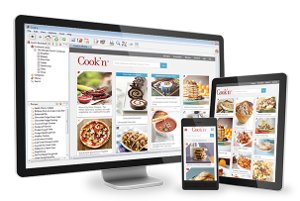
Organize all of your own recipes with the Cook'n Recipe Software. Watch and see how easy it is!
From "1,000 Mexican Recipes." Copyright 2001 by Marge Poore. Used with permission of the publisher, Wiley Publishing, Inc. All Rights Reserved.
02- Ingredients for the Mexican Pantry is from the Cook'n in Mexico collection. Click here to get this CD or download the recipes right now!
Sign up for our free monthly newsletter, with recipes, cooking tips and more!
Enjoy more recipes like this!
__Yucatán Seasoning Pastes 04- Techniques 02- Ingredients for the Mexican Pantry 01- Introduction 03- Kitchen Equipment 05- Menus 06- Mexican Cooking Glossary 07- Mail-Order Sources for Ingredients 08- About Author __Roasting, Peeling and Seeding Fresh Chiles __Roasting Tomatoes __Toasting Dried Chiles __Toasting Dried Herbs and Spices __Toasting Nuts and Seeds __Grinding, Blending, and Frying __Using Banana Leaves __Using Fresh Cactus Paddles __Pressing Tortillas __Hot Tamales For Every Taste __Handling and Preparing Cactus __Chicharrón, a National Snack __Fried Corn Tortilla Chips and Strips __Moles with Poultry __Making Beans Easier to Digest __Pan Tip for Baking Bread __Mexican Chocolate
|
Organize your recipes with the Cook'n recipe software
Piles of recipe cards in your drawer? Download the Cook'n Recipe Software today and get organized!
Cook'n Recipe Software
Regular Price: $99.95
Download: $79.95
CD: $79.95
Availability: Usually ships within 24 hours
Download the full version of the Cook'n Recipe Software right now! Includes over 300 of our best recipes.
|
|
|
|