
The Perfect Sandwich Starts Here
Hey chefs,
A great sandwich is not just about what goes between the slices.
The bread is part plate, part utensil, part ingredient, and part structural engineering. It has to hold everything together, absorb just enough sauce without collapsing, complement the filling without overpowering it, and—ideally—make the entire sandwich more delicious.
And there really isn’t one “best” sandwich bread.
A fluffy white loaf can be perfect for one sandwich and completely wrong for another. A chewy rustic loaf that makes an incredible grilled cheese might turn a delicate cucumber sandwich into a jaw workout. Ciabatta can happily contain roasted vegetables, mozzarella, and pesto, while that same big, open crumb can send chicken salad squeezing through every hole.
The trick is matching the bread to the job.
Start With Structure
Before thinking about flavor, think about what your sandwich physically needs.
A relatively dry, tidy sandwich—turkey, cheese, lettuce, mustard—doesn’t demand much from its bread. A soft sandwich loaf can easily support it.
Now imagine braised beef, melted cheese, caramelized onions, and jus.
Suddenly your bread has a much bigger assignment.
Wet fillings, hot fillings, oily fillings, and heavy fillings need bread with enough structure to hold them without becoming paste. That usually means a thicker crust, a stronger crumb, or both.
Delicate fillings work in the opposite direction. Egg salad, cucumber, soft scrambled eggs, tuna salad, or thinly sliced deli meats often taste better on softer bread because the bread yields as easily as the filling.
Ideally, every bite should break at roughly the same time.
If you have to pull hard enough on the bread that half of the sandwich comes with it, the bread may simply be too tough for the filling.
Look at the Crumb
“Crumb” is the baker’s term for the interior structure of bread, and it matters enormously in sandwiches.
A fine, tight crumb—think classic sandwich bread, brioche, or milk bread—creates an even surface. Mayonnaise, mustard, butter, and other spreads stay where you put them.
That makes these breads particularly good for:
- Deli sandwiches
- Egg sandwiches
- Chicken, tuna, or egg salad
- Peanut butter and jam
- Tea sandwiches
- Breakfast sandwiches
- Grilled cheese
Rustic breads tend to have a more irregular crumb, sometimes with larger holes.
Those pockets are wonderful for catching melted cheese, olive oil, tomato juices, soup, and pan sauces. But they aren’t always ideal for loose fillings.
There is nothing inherently superior about an enormous open crumb. If your chickpeas are dropping through your bread and onto your shirt, those beautiful holes aren’t helping much.
Match the Bread to the Filling
Different bread styles have strengths.
Soft white sandwich bread is tender, neutral, and compressible. It excels when you want the filling to be the star. Think BLTs, deli turkey, tuna salad, peanut butter and jam, or a simple egg sandwich.
Milk bread and brioche bring softness plus richness. They’re especially good with salty or savory fillings such as ham, eggs, fried chicken, sharp cheeses, or rich breakfast sandwiches. Because the bread itself contains more fat—and brioche can be slightly sweet—they can sometimes be too rich for already-heavy fillings.
Sourdough and rustic country loaves have more chew, stronger crusts, and generally more personality. They’re wonderful with grilled cheese, roasted vegetables, hearty meats, sharp cheeses, panini-style sandwiches, and anything involving a little moisture.
Ciabatta has a sturdy crust and open interior that loves olive oil, pesto, tomato, mozzarella, roasted peppers, cured meats, and other Italian-style fillings. Toasting it can make the crust substantially harder, though, so don’t overdo it.
Focaccia already brings olive oil, seasoning, and plenty of flavor to the sandwich. It pairs beautifully with roasted vegetables, mortadella, mozzarella, chicken, pesto, herbs, and Italian meats. Slice it according to the filling; an enormous slab of focaccia can quickly turn into more bread than sandwich.
Rye brings enough flavor that it should be treated as an ingredient rather than merely a container. It’s a natural fit for corned beef, pastrami, mustard, sauerkraut, Swiss cheese, smoked meats, and intensely savory fillings.
Baguettes and crusty French loaves work best with fillings that can stand up to their chew: cured meats, steak, meatballs, roasted vegetables, pâté, strong cheeses, or saucy sandwiches. For easier eating, choose a loaf with a crisp but relatively thin crust rather than one that requires serious effort to bite through.
The Moisture Problem
One of the most important jobs bread performs is moisture management.
You want some absorption.
That’s what makes a sandwich taste cohesive instead of like a stack of unrelated ingredients. Tomato juice soaking slightly into toasted bread is delicious. Beef jus creeping into a crusty roll is delicious. Melted cheese settling into the holes of sourdough is very delicious.
What you don’t want is total saturation.
If your sandwich contains particularly wet ingredients, build barriers.
Fatty spreads such as mayonnaise, butter, pesto, soft cheese, or even melted cheese can help slow moisture from reaching the bread. Lettuce can sometimes serve as another physical barrier.
Tomatoes and other juicy ingredients are usually better placed toward the center of the sandwich rather than directly against untreated bread.
And if the filling is especially wet, toast the bread.
Toasting drives off some moisture and creates a firmer surface, buying you more time before the bread softens.
Toasting Changes the Equation
The same bread can behave almost like two different ingredients depending on whether it’s toasted.
Soft sandwich bread becomes crisp and sturdier.
Sourdough becomes firmer and more assertive.
Brioche becomes deeply browned, buttery, and almost caramelized.
Focaccia gets crisp around the edges while keeping some tenderness inside.
But more toasted isn’t always better.
Bread that begins with a substantial crust can become aggressively crunchy when toasted. If you’re using a rustic loaf, sometimes all it needs is a light toast on the cut surface rather than a full trip through the toaster.
The goal is structure—not dental work.
Then There Is Soup
Soup changes the bread equation entirely.
If your sandwich is being served alongside soup, bread is no longer responsible only for holding the sandwich together.
It’s also probably getting dunked.
And that means texture becomes even more important.
Very soft bread can be lovely with a sandwich, but once dipped into hot soup it may immediately dissolve. A rustic loaf, sourdough, country bread, baguette, or sturdy roll can absorb broth while still maintaining enough structure to make it back to your mouth.
This is one reason grilled cheese and tomato soup work so well together. Toasting gives the bread a crisp exterior and the melted cheese adds richness and structure, while the bread still absorbs a little soup with every dunk.
But different soups call for different breads too.
Rich, creamy soups often benefit from a bread with acidity, chew, or a substantial crust. Think sourdough with potato soup, chowder, creamy tomato soup, or a puréed squash soup.
Brothy soups are wonderful with rustic bread because all those irregular pockets soak up broth.
Hearty stews can handle substantial country loaves, baguettes, or thick slices of grilled bread.
And lighter soups may pair better with a smaller, simpler sandwich so the bread doesn’t dominate the entire meal.
Sometimes the sandwich and soup should contrast.
Creamy soup + crisp sandwich.
Delicate soup + tender sandwich.
Brothy soup + absorbent rustic bread.
Rich soup + tangy or chewy bread.
Thinking about the entire plate rather than just the sandwich usually gives you a better result.
You Don’t Need a Sourdough Starter to Make Great Crusty Bread
There is also a tendency to treat sourdough as though it owns the entire category of good rustic bread.
It doesn’t.
Sourdough is wonderful. A well-fermented loaf has tremendous flavor, a crisp crust, and the kind of chewy interior that makes it equally happy beneath a sandwich or beside a bowl of soup.
But sourdough also comes with a tiny roommate.
You have to acquire or build a starter, feed it, keep it alive, learn what it looks like when it’s active, and figure out how its schedule fits into yours.
Some people love that process.
Some people would simply like to make bread.
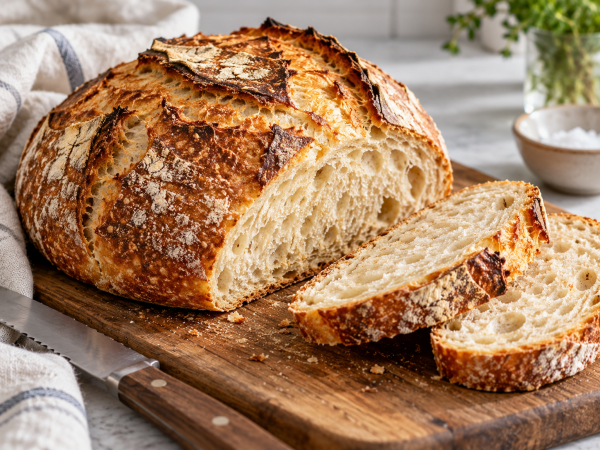
If you’ve been looking longingly at crusty artisan loaves but aren’t quite ready to commit to starter maintenance, yeast-raised rustic breads are a fantastic middle ground.
You can still get that wonderful combination of a crackly exterior and chewy, substantial interior without keeping a living culture on your kitchen counter.
And for sandwiches, that style of loaf is incredibly useful.
It’s sturdy enough for grilled cheese, panini, roasted meats, juicy tomatoes, sharp cheeses, and saucy fillings. Slice it thick and it can stand up to a hearty bowl of soup. Toast it and the surface becomes crisp while the interior remains pleasantly chewy.
It gives you much of what people are looking for when they say they want “sourdough-style” bread—the rustic appearance, substantial crust, satisfying chew, and ability to soak up broth—without requiring you to become responsible for another organism.
The Perfect Sandwich Bread Is the One That Makes the Filling Better
There isn’t a universal answer.
The best bread for a sandwich is the bread that supports everything else you’re trying to accomplish.
Ask yourself:
Is the filling delicate or substantial?
Is it wet or dry?
Does the bread need to absorb juices?
Do I want softness or contrast?
Am I eating it immediately, or packing it for later?
Will I toast it?
And, perhaps most importantly during soup season:
Am I going to dunk it?
Answer those questions and choosing the bread becomes much easier.
And if what you’re after is a versatile, crusty loaf—the kind that can become tomorrow’s grilled cheese, hold up under a hearty sandwich, or tear beautifully into a bowl of soup—you don’t necessarily have to venture into sourdough starter territory to get there.
Here is the link to my favorite rustic loaf recipe. It’s a great place to start if you want that classic crusty-bread experience without having to keep a sourdough starter alive first.
 Brennah Van Wagoner
Weekly Newsletter Contributor since 2025
Email the author! brennah.oaks@gmail.com