
The Science of a Good Swirl
Hey chefs,
There are few things more satisfying than slicing into a loaf of bread and seeing beautiful ribbons of chocolate, cinnamon, nuts, fruit, or caramel running through the middle.
There are also few things more disappointing than slicing into that same loaf and discovering a giant empty tunnel where the filling was supposed to be.
Filled breads look dramatic, but the mechanics behind them are surprisingly practical. A successful swirl depends on getting several things to cooperate at once: the dough has to be strong enough to hold its shape, the filling has to stay where you put it, the layers need enough contact to bake together, and the center needs to cook through without the outside becoming dry.
Once you understand why filled breads leak, gap, or turn gummy, they become much easier to troubleshoot.
And yes, there is a little science involved.
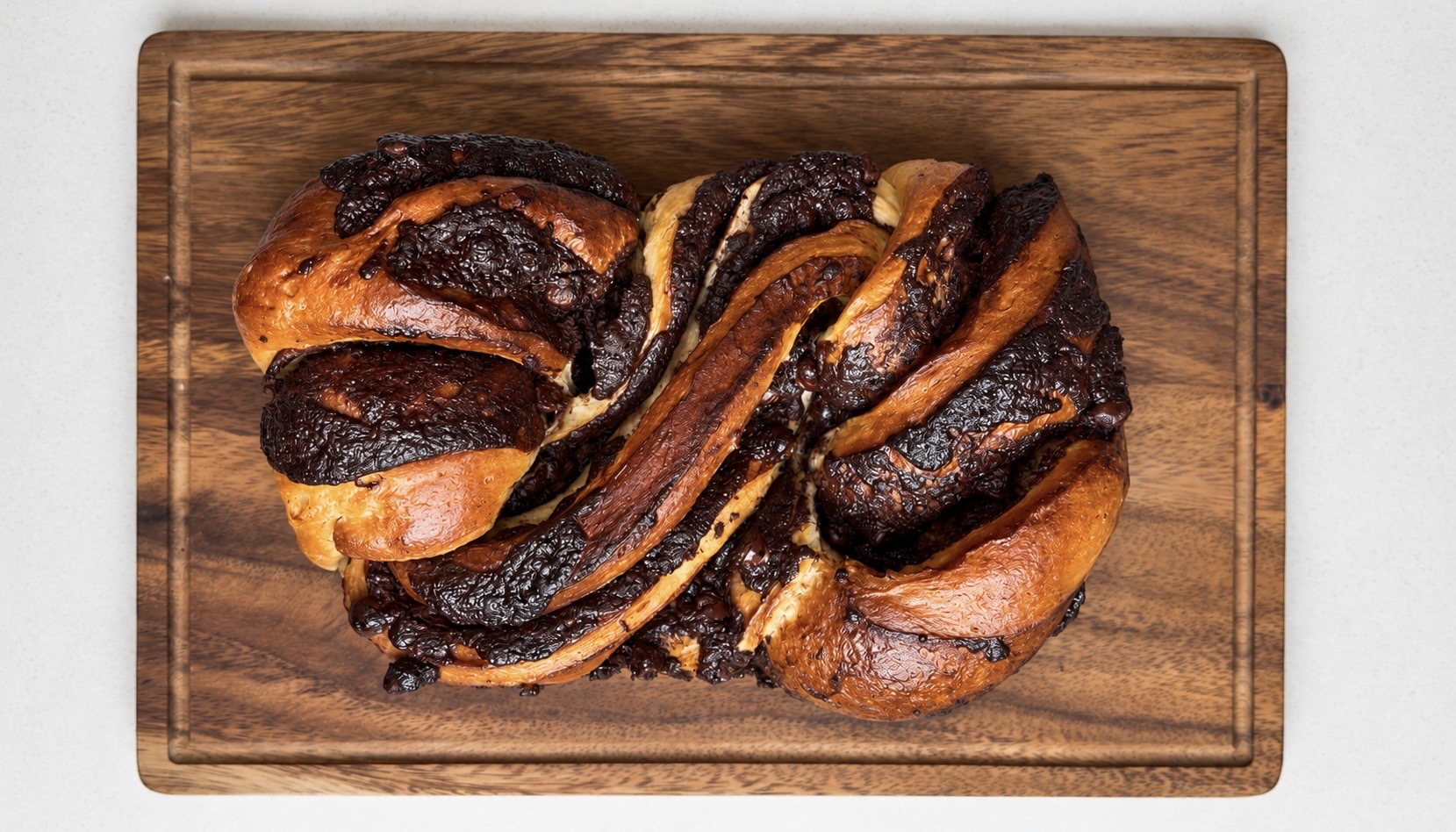
First: A Swirl Is Basically a Stack of Tiny Layers
When you roll up a filled dough, you are creating alternating layers of bread and filling.
During baking, the dough expands as yeast produces gas and steam forms inside the dough. Meanwhile, butter melts, sugar dissolves, chocolate softens, and fruit releases moisture.
That means your beautifully tidy spiral is about to become a very active little environment.
For the swirl to stay intact, the layers need to expand at roughly the same rate while still maintaining enough contact with one another to bake into a cohesive loaf.
If the filling becomes too liquid, it can slide out.
If the dough rises too aggressively away from the filling, you can get gaps.
If too much moisture gets trapped between the layers, the center can stay dense or gummy.
The best filled breads are essentially an exercise in controlled chaos.
The Filling Should Be Spreadable, Not Pourable
One of the biggest causes of leaking is simply a filling that is too loose.
Think about the difference between spreading softened butter onto dough and pouring melted butter onto it.
Softened butter stays relatively close to where you put it.
Melted butter immediately starts moving.
The same principle applies to chocolate fillings, cinnamon fillings, nut pastes, caramel, fruit spreads, and almost anything else you might roll into dough.
Ideally, your filling should be soft enough to spread into a thin, even layer but thick enough that it does not run when the dough is rolled.
Chocolate fillings often work particularly well when cocoa, chocolate, sugar, and fat are combined into a paste rather than simply brushing the dough with melted chocolate.
For cinnamon rolls, mixing softened butter with the sugar and spices can help create a more stable filling than pouring melted butter over the dough and sprinkling sugar on top.
Fruit fillings usually benefit from being fairly concentrated. Thin jam, juicy berries, or watery fruit purées can release a surprising amount of liquid as they heat.
The goal is not to eliminate moisture. It is to control it.
More Filling Is Not Always Better
This may be the least exciting advice in this entire article, but it is important:
There is such a thing as too much filling.
I know. Tragic.
A thick layer of chocolate or cinnamon sugar sounds like an obvious improvement, but filling creates a barrier between layers of dough. If that barrier becomes too thick, the dough cannot easily adhere to itself.
Instead of baking into a connected spiral, the layers may separate.
Extra filling can also liquefy during baking, pool at the bottom of the pan, or create an underbaked strip through the center.
You want enough filling to taste generous without turning the loaf into bread wrapped around a molten interior.
A relatively thin, even layer usually gives you a prettier swirl and a better texture than giant pockets of filling.
Leave Yourself a Small Clean Edge
When spreading the filling, it helps to leave a narrow strip of bare dough along the edge where you will finish rolling.
As the dough is rolled, the filling naturally gets pushed toward the outside edge.
If the filling already extends all the way to the border, it has nowhere to go except out.
That clean strip gives you a little room to seal the final edge of the dough and helps keep the filling tucked inside.
You do not need several inches of bare dough. Even a small border can make the roll much easier to manage.
Roll Snugly—But Do Not Strangle the Dough
A loose roll creates large pockets between the layers.
Those pockets become even larger as the dough proofs and expands, which can leave you with hollow spaces inside the finished bread.
But rolling extremely tightly causes a different problem.
If you compress the dough too aggressively, the filling gets squeezed outward and the dough can have trouble expanding evenly during proofing.
Think snug rather than tight.
You want the layers sitting closely against one another without flattening the dough.
A good rule of thumb is that the roll should hold its shape when you move it, but filling should not be squirting out the ends.
Very scientific terminology, obviously.
Why Gaps Form Inside Filled Bread
The dreaded swirl gap usually happens when the dough pulls away from the filling as it rises or bakes.
There are several possible causes.
A very thick filling can prevent the dough layers from bonding. Excess flour left on the surface of the dough can do the same thing. A loose roll may leave air pockets from the beginning.
Proofing also matters.
If a loaf is underproofed, it can experience a dramatic burst of expansion in the oven. That sudden movement can pull the layers apart.
An overproofed loaf may have weakened gluten structure and struggle to support itself.
A properly proofed loaf already contains a network of expanded gas bubbles, so its oven spring tends to be more controlled.
In other words, the swirl does not have to survive quite as violent a growth spurt.
Chilling Can Make Complicated Doughs Much Easier
If your dough is soft, buttery, or heavily filled, refrigeration can be incredibly useful.
Cold dough is firmer and easier to cut, twist, braid, or transfer into a pan.
Cold filling is also less likely to ooze everywhere while you work.
This is particularly helpful with breads like babka, where a filled log may be sliced open and twisted before baking.
Trying to cut through very soft dough filled with warm chocolate can quickly turn into something that looks less like elegant pastry work and more like a crime scene.
A short chill firms the fat and chocolate without necessarily freezing the dough solid.
It gives you cleaner cuts, more visible layers, and considerably less swearing.
But Do Not Add Huge Amounts of Flour Just to Make the Dough Easier to Handle
Rich doughs can feel softer and stickier than lean bread doughs.
That does not necessarily mean they need more flour.
Adding too much flour during rolling can make the finished bread dry and can also interfere with the layers sticking together.
Use just enough flour to keep the dough from attaching itself permanently to your counter.
A lightly floured surface is very different from burying your dough in a snowdrift.
If the dough is extremely soft, chilling is often a better solution than continually adding flour.
Sugar Is Sneakier Than It Looks
Sugar does more than make a filling sweet.
It attracts water.
This is one reason cinnamon-sugar fillings can turn syrupy in the oven. As the sugar dissolves and pulls moisture from the surrounding dough, it forms a liquid syrup with the melted butter.
Some of that is desirable. It creates those sticky, caramelized layers we love.
Too much, though, can create a slippery layer between the dough coils or collect at the bottom of the pan.
Brown sugar tends to bring even more moisture to the party because it contains molasses.
Again, this does not mean you should avoid it. It simply means filling ratios matter.
The bread, butter, sugar, and moisture all have to stay reasonably balanced.
Watch Out for Very Wet Fruit Fillings
Fruit is one of the trickiest things to add to a swirled bread because it contains so much water.
Fresh berries can burst.
Apples release juice.
Jam becomes thinner when heated.
Fruit purées can soak directly into the dough.
For fruit-filled breads, concentrated fillings usually perform better.
Think thick apple butter rather than applesauce, cooked berry filling rather than raw berry purée, or a relatively firm jam rather than something loose and syrupy.
Small pieces of fresh fruit can absolutely work, but they are usually most successful when used in moderation and paired with a filling sturdy enough to help hold them in place.
Small Pieces Usually Beat Big Chunks
Whether you are adding chocolate, nuts, fruit, or something else, smaller pieces generally create cleaner swirls.
Large chunks can physically interrupt the dough layers.
They can tear through the dough while you roll it, create gaps around themselves during baking, and make slicing the dough difficult.
Finely chopped chocolate melts into the layers more evenly.
Finely chopped nuts distribute throughout the swirl instead of creating giant pockets.
Small pieces of fruit are less likely to puncture the dough.
You still get texture, just without asking the bread to perform structural engineering around a walnut the size of a golf ball.
The Second Rise Matters More Than People Think
After shaping, filled breads usually need another period of proofing before they go into the oven.
This is not just about making the loaf bigger.
It gives the dough time to relax and expand into its new shape.
If you bake it too early, the dough may expand rapidly in the oven and pull apart along the swirl.
The exact proofing time will depend on the dough, the temperature of your kitchen, and how cold the dough was when you shaped it.
Instead of relying entirely on the clock, look at the bread.
The dough should look noticeably puffed and lighter than when it was first shaped. A gentle press should leave an indentation that slowly begins to spring back.
If it snaps back immediately, it probably needs more time.
If it collapses dramatically and does not recover at all, it may have gone too far.
Bread recipes give you times.
The dough gets the final vote.
Why Filled Breads Are So Easy to Underbake
A plain loaf of bread has a relatively simple job.
A filled loaf has alternating layers of dough, sugar, fat, chocolate, fruit, or whatever else you have decided to stuff into it.
Those layers slow heat transfer and make the center harder to judge.
Meanwhile, the outside may look beautifully browned long before the inside is finished.
This is one reason babka, cinnamon rolls, and other enriched breads can occasionally look perfect and then reveal a dense, slightly gummy center.
Do not assume deeply golden means done.
If the bread is browning too quickly, tent it loosely with foil and continue baking until the center is cooked.
For particularly thick enriched loaves, an instant-read thermometer can also be helpful. The exact ideal temperature varies somewhat by formula, but enriched breads are generally fully baked once the center is around 190–200°F.
Temperature is a tool, not the only test. You should also consider the structure, color, and recipe.
And Sometimes the “Gummy” Part Is Actually Melted Filling
There is another complication.
Hot chocolate, butter, cinnamon sugar, and fruit fillings can make freshly baked bread appear wetter than it actually is.
If you slice a filled loaf immediately after it comes out of the oven, the interior may look alarmingly soft.
Some of that moisture will redistribute as the bread cools.
Chocolate will begin to set.
Syrups will thicken.
The crumb itself will stabilize.
That is why cooling is part of the baking process.
I fully understand that telling someone to stare at a warm chocolate-filled loaf without cutting into it is unreasonable.
Unfortunately, physics remains unsympathetic.
A Little Leakage Is Not a Failure
Even a well-made filled bread may lose a little butter, chocolate, caramel, or cinnamon syrup while it bakes.
That is normal.
In fact, some of those escaped sugars and fats create the caramelized edges that make filled breads so good.
The goal is not to produce a hermetically sealed pastry.
The goal is to keep enough filling between the layers that every slice gets a beautiful swirl while allowing the dough itself to bake properly.
A few crispy chocolatey bits stuck to the edge of the pan are not a mistake.
They are arguably the baker’s tax.
The Formula for a Better Swirl
If you want a filled bread that slices beautifully, keep these ideas in mind:
Use a filling that is thick and spreadable rather than runny. Apply it in a relatively thin, even layer. Roll the dough snugly without crushing it. Keep excess flour off the surface. Chill very soft dough before intricate shaping. Give the shaped bread enough time to proof. And most importantly, make sure the center has enough time to bake.
The prettiest swirls are not necessarily the ones with the most filling.
They are the ones where the dough and filling have been designed to work together.
And once you get that balance right, slicing into the finished loaf is extremely satisfying.
Especially when there is chocolate involved.
Ready to Put All That Swirl Science to Work?
My Salted Chocolate Milk Bread Babka uses an ultra-soft tangzhong dough, a rich chocolate filling, and chopped chocolate throughout the layers for a loaf that is fluffy, deeply chocolatey, and very much worth twisting dough into knots for.
 Brennah Van Wagoner
Weekly Newsletter Contributor since 2025
Email the author! brennah.oaks@gmail.com