
Why Food Tastes Better the Next Day
Hey chefs,
There are certain foods that seem to pull off a small miracle overnight.
Chili tastes deeper. Lasagna holds together better. A pot of soup that was good yesterday suddenly tastes like it has been simmering for twice as long. Braised meat feels richer. Tomato sauce seems more balanced. Even some cakes and desserts somehow become better after a night of doing absolutely nothing in the refrigerator.
It is easy to describe this as flavors “marrying,” which is one of those wonderfully vague cooking phrases that gets used all the time.
But there is actually quite a bit happening.
Food does not stop changing the second you turn off the stove. Moisture keeps moving. Salt continues to distribute. Starches absorb liquid and reorganize as they cool. Gelatin firms and melts again. Aromatic compounds move through fat. Spices soften and blend into the rest of the dish.
Sometimes all of that makes food noticeably better.
And sometimes it turns your beautiful crispy potatoes into sad little refrigerator sponges.
The trick is knowing which foods benefit from time—and why.
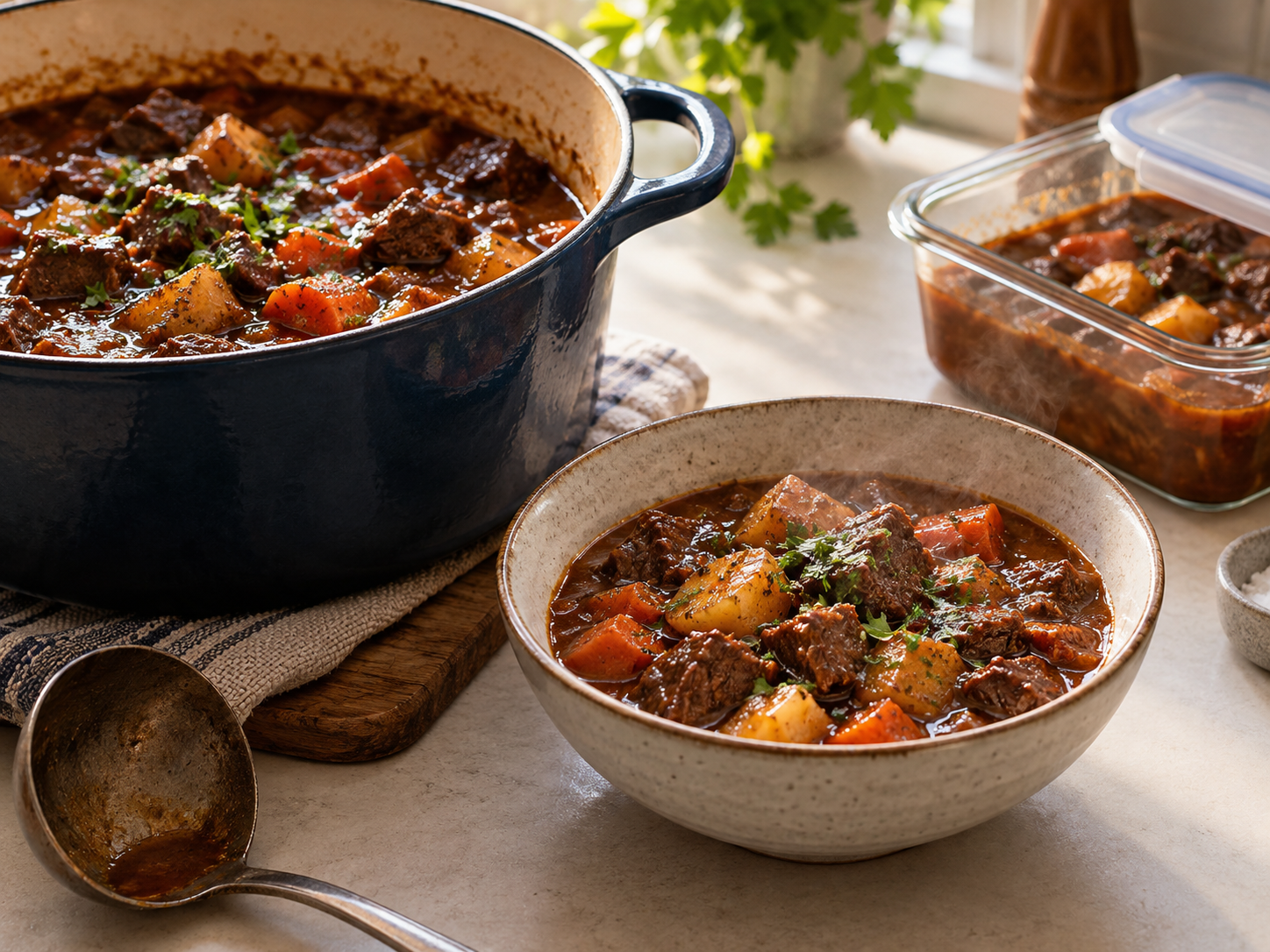
Flavor Keeps Moving After Cooking
When you make something complex like chili, curry, soup, Bolognese, or a braise, you are combining dozens of flavor compounds from different ingredients.
Some dissolve in water.
Some dissolve more readily in fat.
Others are released when ingredients are browned, crushed, toasted, simmered, or heated.
When a dish first comes off the stove, all those flavors are present, but they are not necessarily distributed evenly.
Maybe one bite has more garlic. Another has more tomato. A piece of meat tastes heavily seasoned on the outside but milder in the center.
As the food rests, compounds continue moving through the liquid and fat surrounding them.
That is essentially what cooks mean when they say the flavors have had time to “marry.”
Instead of tasting a collection of separate ingredients, the dish begins to taste more like one unified thing.
Fat Is Doing More Than Making Food Rich
Fat is one of the most important flavor carriers in cooking.
Many aromatic compounds dissolve better in fat than they do in water, which means butter, olive oil, cream, coconut milk, cheese, and rendered meat fat all help capture and distribute flavor throughout a dish.
This is especially important with spices.
The aromatic compounds in things like cumin, coriander, paprika, chili, black pepper, cinnamon, and many other spices are particularly good at dissolving into fat.
Give them more time in a finished dish and their flavor can become more evenly dispersed.
The spices have not disappeared.
They have simply stopped shouting individually.
Spices Mellow and Integrate
Freshly cooked spices can taste surprisingly sharp.
Garlic may still feel aggressive. Black pepper can be very obvious. Chile heat may hit abruptly. Certain dried spices can even taste slightly dusty or harsh when they have not had enough time to hydrate and settle into a sauce.
After several hours, those sharper edges often soften.
This does not necessarily mean the flavor becomes weaker.
It becomes more integrated.
Think of the difference between hearing five musicians warming up separately and hearing those same musicians play together.
All the notes are still there.
They just make more sense.
Salt Has More Time to Travel
Salt does not somehow become saltier overnight.
But it does have more time to move through the food.
If you have ever made soup or stew and noticed that the broth seemed well seasoned while the vegetables or beans tasted slightly bland, this is part of what is happening.
Over time, dissolved salt moves between the liquid and the solid ingredients.
The result is often a dish that tastes more evenly seasoned the next day.
This is also why it is smart to taste leftovers before automatically adding more salt.
Yesterday’s slightly under-seasoned stew may have corrected itself while you were asleep.
Starches Keep Absorbing Moisture
This is one of the biggest reasons leftovers can change so dramatically.
Rice, pasta, potatoes, beans, flour-thickened sauces, and other starchy foods continue interacting with water after cooking.
Starch granules absorb water as they cook, swell, and soften.
But the story does not end there.
Moisture continues redistributing through the dish as it cools and rests.
That is why a soup that looked slightly thin at dinner can seem dramatically thicker the next morning.
It is also why lasagna and baked pasta often slice so much more cleanly the next day.
The noodles have absorbed some of the surrounding sauce, the layers have settled, and the whole structure has become more cohesive.
Sometimes this is exactly what you want.
Other times your beautiful noodle soup wakes up having absorbed half the broth and decided it would rather be a casserole.
Cooling Changes Starch Structure
Cooked starch also changes physically as it cools.
As starch molecules cool, they begin reorganizing into a more ordered structure in a process called retrogradation.
You have probably seen the results many times.
Cold rice becomes firmer.
Potatoes become more solid after chilling.
Bread becomes less soft as it sits.
A chilled lasagna holds its shape much more cleanly than one straight from the oven.
This change in texture also changes how we experience flavor.
A sauce that felt loose when freshly made may feel richer and more substantial after resting and reheating.
Sometimes when we say a dish “tastes better,” part of what we are actually responding to is improved texture.
Flavor and texture are much more connected than we tend to give them credit for.
Gelatin Makes Braises Especially Good Leftovers
Slow-cooked meat dishes have another advantage.
Cuts like chuck roast, short ribs, pork shoulder, and other collagen-rich meats contain connective tissue that gradually breaks down during cooking.
That collagen converts into gelatin.
Gelatin gives good stocks and braises their silky, luxurious texture.
When the dish cools, the gelatin firms.
When you reheat it the next day, it melts again.
By that point, the gelatin, sauce, fat, and meat juices have had time to redistribute, which can make the entire dish feel richer and more cohesive.
This is one reason beef stew, pot roast, short ribs, and similar dishes are such good make-ahead foods.
And as a bonus, chilling also causes excess fat to solidify on the surface, making it incredibly easy to remove if you want a cleaner sauce.
Sometimes refrigeration does part of the prep work for you.
Tomato Sauces Love a Little Time
Tomato-based dishes are some of the most reliable next-day winners.
Cooked tomatoes contain water, sugar, acid, glutamates, and a huge range of aromatic compounds.
Then we tend to add things like onion, garlic, herbs, olive oil, meat, cheese, wine, stock, or spices.
That is a lot going on in one pot.
Time gives those components a chance to redistribute and settle into one another.
The acidity of the tomatoes can also feel less sharp once it is balanced more thoroughly throughout the dish with fat, salt, sweetness, and savory flavors.
This is part of why marinara, meat sauce, chili, and tomato-heavy braises can taste so wonderfully rounded the following day.
They have had time to get acquainted.
Some Foods Are Genuinely Better Made Ahead
There are some dishes I would happily make the day before on purpose.
Soups and stews are obvious.
So are chili, curry, braised meat, baked pasta, lasagna, meat sauce, beans, and many casseroles.
Some desserts improve too.
Spice cakes can become softer and more aromatic after resting.
Cheesecake needs time to chill and fully set.
Tiramisu relies on resting so the layers can hydrate and become cohesive.
Layer cakes can sometimes improve after filling because moisture gradually moves between the frosting or filling and the cake itself.
In those cases, resting is not just a storage step.
It is part of finishing the dish.
But Crispy Food Is Another Story
There is one major exception to this entire discussion.
Crispy food.
Crispness depends on dryness.
Unfortunately, food is full of water, and water is constantly moving from wetter areas toward drier ones.
That means the crisp crust on fried chicken slowly absorbs moisture.
Breadcrumb toppings soften.
Roasted potatoes lose their crackly edges.
Toast gets soggy.
Dressed salad wilts.
A refrigerator does not care how hard you worked on that crust.
If the primary reason a food is delicious is because it crunches, it is usually best eaten relatively fresh.
Fresh Herbs Lose Their Edge Too
Fresh herbs are another category that generally does not improve with age.
Basil, cilantro, parsley, mint, dill, and other herbs contain volatile aromatic compounds responsible for their bright, fresh flavor.
Those compounds fade over time.
Fresh herbs can also wilt, darken, and lose some of their clean flavor when they sit in cooked or acidic foods.
This creates a useful strategy for leftovers.
Let the stew, sauce, or curry rest overnight.
Then add fresh herbs again when you serve it.
The base gets the benefit of time while the garnish stays bright.
Best of both worlds.
Acid May Need a Refresh
Finishing acids like lemon juice and vinegar are often most noticeable immediately after they are added.
As a dish rests, that acidity becomes more evenly distributed and can seem less sharp.
Sometimes that is exactly what you want.
Other times, a leftover dish can taste slightly heavy or flat even though it tasted perfectly balanced the night before.
Before reaching automatically for the salt, try acid.
A small splash of vinegar or squeeze of lemon can restore brightness surprisingly quickly.
It is one of the easiest ways to make leftovers taste freshly cooked again.
Aromas Can Fade During Storage
Time improves some aspects of flavor, but not all of them.
Many aromas are produced by volatile compounds, which means they readily escape into the air.
That wonderful smell when you first tear basil?
Volatile compounds.
Fresh citrus zest?
Volatile compounds.
Freshly ground pepper?
Also volatile.
Every time food is cooked, cooled, uncovered, stored, and reheated, some of those aromatic compounds can be lost.
This is one reason leftovers sometimes taste rich and savory but slightly dull.
The solution is often not to re-season the whole dish.
It is to add something fresh.
Try citrus zest, fresh herbs, freshly cracked pepper, a drizzle of olive oil, yogurt, cheese, scallions, or another fresh finishing ingredient.
A little contrast can make an old dish feel new again.
Reheating Is Part of the Equation
A leftover dish is only as good as the way you reheat it.
Cold temperatures suppress aroma.
Fat firms.
Gelatin sets.
Sauces thicken.
All of that means a spoonful of stew straight from the refrigerator can taste dramatically less flavorful than the exact same stew once it is hot.
Heat releases aroma again, melts fat and gelatin, and changes the way we perceive seasoning.
If something has thickened substantially overnight, add a little appropriate liquid as it reheats.
Water, stock, milk, cream, or tomato sauce may all make sense depending on the dish.
You are not necessarily diluting it.
You are often just replacing moisture that the starches absorbed while the dish was resting.
Those starches have been busy.
Taste Again Before Serving
This may be the most useful leftover advice of all.
Treat reheated food like food you are still cooking.
Taste it.
Does it need salt?
Acid?
Water?
Something fresh?
Something crunchy?
A little fat?
Professional cooking involves an enormous amount of tasting and adjusting.
You do not simply follow the recipe, reach the end of the instructions, and declare the food permanently finished.
Food changes.
Your seasoning can too.
So Why Does Food Taste Better the Next Day?
Usually, it is a combination of several things happening at once.
Salt becomes more evenly distributed.
Fat carries aromas throughout the dish.
Spices soften and integrate.
Starches continue absorbing moisture.
Gelatin settles and redistributes.
Textures become more cohesive.
The individual ingredients stop tasting quite so separate from one another.
The foods that benefit the most tend to have lots of moisture, multiple layers of flavor, plenty of time-friendly ingredients, and no requirement to stay crisp.
That describes a lot of our favorite comfort foods.
Stews.
Curries.
Chili.
Lasagna.
Beans.
Braised meats.
Tomato sauces.
Which means all those people insisting that the leftovers are better the next day?
They may actually be right.
Sometimes being a good cook means knowing exactly when to stir, season, sear, reduce, and adjust.
And sometimes it means knowing when to put the lid on, put dinner in the refrigerator, and leave it alone until tomorrow.
 Brennah Van Wagoner
Weekly Newsletter Contributor since 2025
Email the author! brennah.oaks@gmail.com