
How to Make Food Look Better Without Getting Fussy
Hey chefs,
We eat with our eyes first.
It is a cliché because it is true.
A bowl of pasta can taste exactly the same whether it is dumped onto a plate in one big heap or twirled neatly with a little Parmesan scattered over the top—but somehow, the second one already seems more delicious before you even take a bite.
The good news is that making food look beautiful does not require tweezers, edible flowers, or a culinary-school plating kit.
Most of the time, it comes down to a few very simple things:
Good color.
A little contrast.
Thoughtful placement.
The right serving dish.
And knowing when to stop touching it.
You do not need to turn Tuesday-night dinner into fine dining.
You just need to make the food look like you meant to put it there.
Start With the Food, Not the Garnish
The easiest way to make food look good is to cook it well.
Deeply browned chicken already looks more appealing than pale chicken.
Roasted vegetables with caramelized edges are prettier than vegetables that have steamed until soft and beige.
A loaf of bread with a golden crust does not need much decoration.
Before thinking about garnishes, ask whether the food itself has enough color and texture.
This is one reason browning matters so much.
The Maillard reaction—the series of chemical reactions responsible for much of the flavor and color in seared meat, toasted bread, roasted vegetables, and countless other foods—does double duty.
It makes food taste better.
And it makes food look better.
A little golden color goes a very long way.
Choose the Right Plate
Plating actually starts before the food touches the plate.
The dish you choose changes the way the food looks.
If the plate is too small, everything feels crowded.
If it is enormous, a normal portion can look strangely tiny.
A good rule is to leave some visible space around the food.
You do not need a giant restaurant plate with three ravioli floating in the middle, but giving the food a little breathing room instantly makes it look more intentional.
Color matters too.
White and cream dishes are classics because almost everything shows up well against them.
Dark plates can make pale foods look dramatic.
Rustic pottery works beautifully with cozy braises, breads, roasted vegetables, and family-style meals.
And sometimes the prettiest presentation is not a plate at all.
A colorful salad may look fantastic in a wide shallow bowl.
Roasted vegetables can be beautiful piled onto a platter.
Bread usually looks better in a basket or on a wooden board than sitting alone on a dinner plate.
Use the dish that makes sense for the food.
Stop Centering Everything
One of the easiest ways to make a plate feel a little more polished is to stop placing everything directly in the center like a bullseye.
Try positioning the main component slightly off-center.
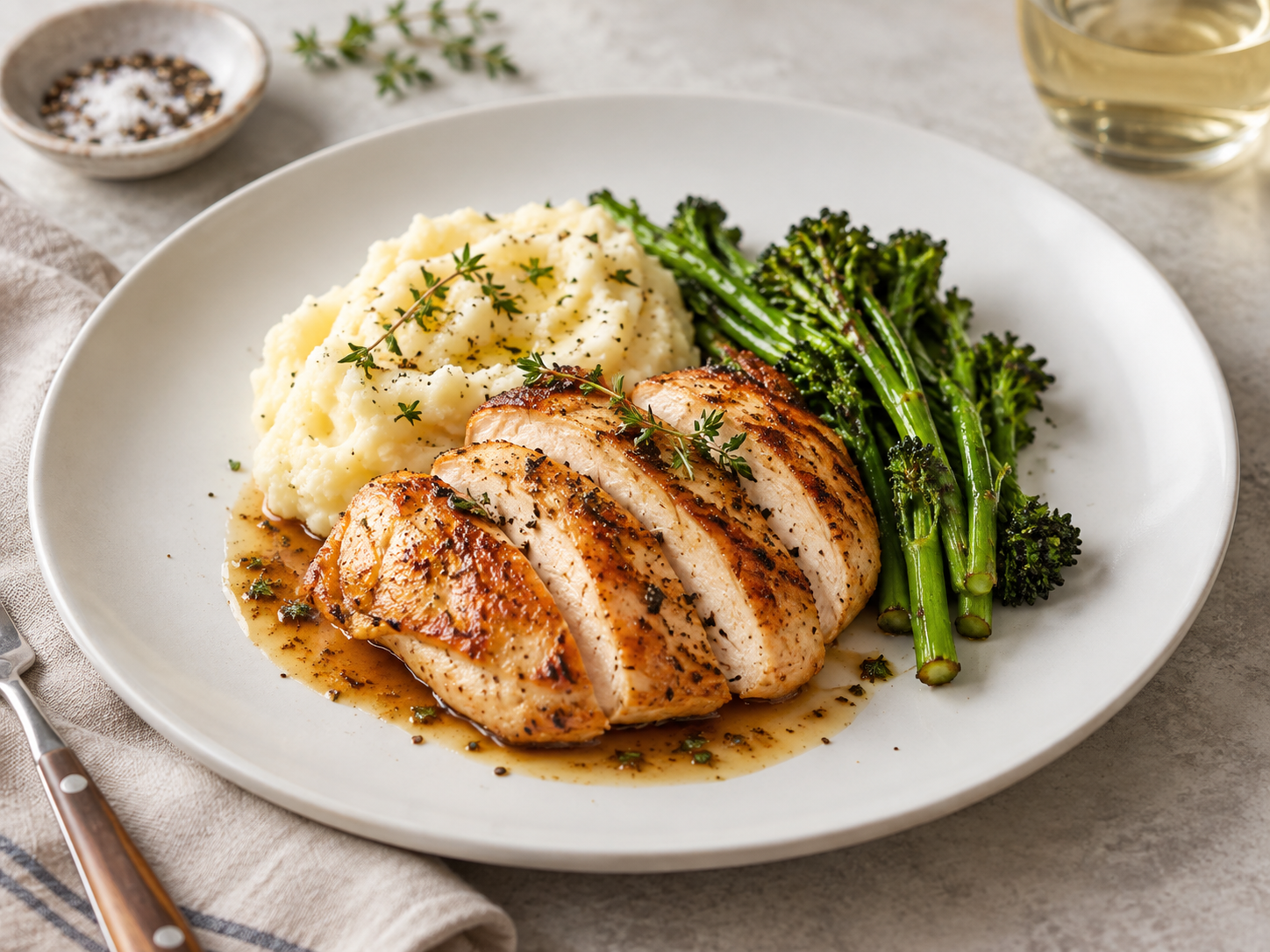
Lean sliced meat against mashed potatoes.
Place roasted vegetables alongside rather than directly underneath.
Spoon sauce partially around the food instead of drowning the entire plate.
You are not trying to create some complicated geometric masterpiece.
Slight asymmetry simply tends to look more natural and relaxed.
Think composed, not engineered.
Height Helps
Food tends to look more interesting when everything is not lying completely flat.
You can create height without constructing an architectural tower.
Pile salad loosely instead of pressing it down.
Stack two or three pancakes slightly askew.
Rest sliced chicken against a mound of potatoes.
Twirl pasta rather than spreading it across the entire plate.
Overlap slices instead of laying them side by side.
Even a small amount of height adds dimension and makes a plate feel more generous.
Use Contrast
Beautiful food usually has contrast.
Color contrast is the obvious one.
Bright green herbs over creamy pasta.
Red tomatoes against white mozzarella.
Golden chicken beside green vegetables.
Dark chocolate against pale cream.
But contrast can also come from texture.
A creamy soup becomes more visually interesting with crunchy croutons.
Smooth mashed potatoes look better with crisp-edged meat.
Soft pasta benefits from toasted breadcrumbs or grated cheese.
A silky dessert can use chopped nuts or a crisp cookie alongside it.
The goal is not to decorate the plate.
The goal is to let the appearance hint at what eating it will feel like.
Show People What Is in the Food
The best garnishes usually tell you something about the dish.
If there is basil in the pasta, a little fresh basil on top makes sense.
If a dessert contains lemon, a little finely grated lemon zest can reinforce that.
If toasted walnuts are mixed into a salad, a few visible walnut pieces tell you what to expect.
This is one of the simplest ways to avoid fussy plating.
Garnish with the ingredients that are already part of the food.
Random parsley has spent decades bravely trying to decorate dishes it has absolutely nothing to do with.
We can let it retire.
Save Something Fresh for the End
Cooking dulls color.
That is sometimes exactly what we want, but it means a finished dish can occasionally look a little muted.
Saving a small amount of something fresh for the end can bring everything back to life.
Fresh herbs are the obvious example.
But it could also be:
Freshly grated citrus zest.
Thinly sliced scallions.
A few raw tomato pieces.
Fresh berries.
Finely grated Parmesan.
A drizzle of olive oil.
A sprinkle of toasted seeds.
A little flaky salt.
The key word is little.
You are finishing the dish, not burying it.
Sauce With Intention
Sauce is one of the quickest ways to make a plate either beautiful or slightly chaotic.
The easiest method is usually to sauce the food where it makes sense and leave some of the food visible.
If you made beautifully crisp chicken, do not completely cover the crust with sauce.
Spoon sauce underneath it or around part of it.
For pasta, toss the noodles thoroughly with the sauce rather than pouring a puddle over the top.
For desserts, a little sauce can be spooned alongside or underneath rather than zigzagged back and forth across the plate like it is 1997.
You do not need squeeze-bottle art.
You just want the sauce to look intentional.
Give Pasta a Little Shape
Pasta is one of the easiest foods to make look significantly better with almost no extra work.
Instead of scooping a tangled pile onto the plate, use tongs to twist long pasta into a loose mound.
You do not need the perfect restaurant twirl.
Just gather the strands slightly so they have shape and height.
Then spoon any remaining sauce around or over the pasta and finish with whatever belongs there—cheese, herbs, black pepper, breadcrumbs, or olive oil.
It takes about ten extra seconds and makes a surprisingly large difference.
Slice Meat Before Serving—Sometimes
A whole chicken breast or steak can look great on a plate.
But slicing meat can be especially useful when you want to show off the interior.
A beautifully cooked steak with a rosy center suddenly becomes much more visually appealing when you can actually see that center.
The same goes for stuffed chicken, pork tenderloin, roulades, or anything with an interesting filling.
When slicing, use a sharp knife and arrange the pieces with a slight overlap.
Do not fan them into a perfect semicircle unless that is actually the look you want.
Loose and natural usually feels more inviting.
And remember that not everything needs to be sliced.
A crispy chicken thigh often looks better left whole because the skin is the star.
Be Careful With the Plate Rim
This may be the single easiest restaurant trick to steal.
Before serving, look at the edge of the plate.
If there is a smear of sauce, stray breadcrumb, fingerprint, or splash of soup, wipe it away.
That is it.
You do not need special equipment.
A clean towel or paper towel works perfectly well.
A clean rim gives the food a frame.
And suddenly the whole plate looks much more polished.
Family-Style Food Can Be Beautiful Too
Not everything has to be individually plated.
In fact, some foods look better served communally.
A whole roast chicken surrounded by vegetables can be far more impressive than eight carefully plated portions.
A big bowl of pasta with Parmesan and herbs scattered over the top feels abundant and inviting.
A tray of roasted vegetables with different colors and textures can become the centerpiece of the table.
When serving family-style, use the same principles:
Choose a vessel large enough for the food.
Build a little height.
Let some individual ingredients remain visible.
Add fresh finishing elements at the end.
And do not overcrowd the platter.
Abundance looks wonderful.
A traffic jam does not.
Color Matters More Than Complexity
If a plate looks dull, you usually do not need a more complicated garnish.
You may just need color.
Imagine roast chicken, mashed potatoes, and gravy.
Delicious.
Also extremely beige.
Add green beans, roasted carrots, a bright salad, or fresh herbs and suddenly everything looks much more appealing.
When planning meals, I like to think about color the same way I think about flavor.
If every component is brown, cream, and tan, perhaps the meal needs something green, red, orange, or purple.
This does not mean forcing brightly colored ingredients into every recipe.
It simply means paying attention to the overall plate.
Use Odd Numbers When It Makes Sense
Three scallops often look nicer than four.
Five ravioli can look more natural than six.
Three little clusters of garnish are often prettier than four perfectly symmetrical ones.
This is an old visual-design principle: odd-numbered groupings often feel more relaxed and interesting.
But please do not remove a meatball from someone’s dinner because plating theory says five is prettier than six.
Food is still dinner.
Let Some Things Be Messy
There is a difference between messy and careless.
A rustic fruit galette should look rustic.
A pile of crispy fried chicken does not need to be arranged with surgical precision.
A gooey cinnamon roll should look gooey.
A burger should probably look like something you need two hands and several napkins to eat.
Trying to make inherently casual food look perfectly controlled can actually make it less appealing.
Some of the best food photography and presentation lets the food behave like food.
Sauce drips.
Cheese melts.
Crumbs fall.
Juices run.
That can be beautiful too.
Don’t Garnish Just Because You Feel Like You Should
There is always a dangerous moment at the end of cooking when you look at a finished plate and think:
It needs something.
Sometimes it does.
Sometimes you are simply experiencing garnish panic.
Before adding anything, ask:
Does this ingredient taste good with the dish?
Does it add useful color or texture?
Does it help explain what is in the food?
If the answer is no, leave it alone.
Not every plate needs herbs.
Not every dessert needs powdered sugar.
Not every bowl of soup requires a perfect swirl of cream.
Restraint is one of the most useful plating skills.
Think About the First Bite
Presentation should never make food harder to eat.
That giant rosemary branch sticking vertically out of the potatoes?
Pretty for approximately three seconds.
Then somebody has to remove it.
A garnish should usually either be edible or very obviously removable.
Likewise, do not create a beautiful stack of food that collapses the second someone touches it.
The point of presentation is to make people more excited to eat dinner.
Not nervous about destroying it.
The Five-Second Check
Before bringing food to the table, take five seconds and look at it.
Ask yourself:
Is the plate too crowded?
Can I see the different components?
Would a little fresh color help?
Is there sauce or food smeared around the rim?
Does anything look awkward?
Do I actually need another garnish?
Often, one tiny adjustment is all it takes.
Move the vegetables slightly.
Wipe the edge.
Add a twist of black pepper.
Scatter a few herbs.
Then stop.
Good Presentation Is Really About Attention
You do not need restaurant equipment or elaborate plating techniques to make beautiful food.
You need to pay attention.
Cook things until they have good color.
Choose a plate that fits.
Leave a little breathing room.
Create some height.
Use contrasting colors and textures.
Garnish with ingredients that make sense.
Keep the plate clean.
And know when the food is finished.
Because beautiful presentation should not distract from dinner.
It should make you look at the plate and think:
I really want to eat that.
And ultimately, that is the whole point.
 Brennah Van Wagoner
Weekly Newsletter Contributor since 2025
Email the author! brennah.oaks@gmail.com