
Panic-Free Cooking: The Swaps Every Cook Should Know
Hey chefs,
Every cook knows the feeling.
You’re halfway through a recipe, the butter is melting, the flour is measured, and suddenly you read the next line:
“…add buttermilk.”
You open the fridge.
There is no buttermilk.
For a lot of people, that’s the moment the recipe dies. They abandon the project, order takeout, or convince themselves the recipe must be impossible without that one ingredient.
But here’s the truth professional kitchens understand:
Cooking is flexible. Baking is precise — but it’s still adaptable when you understand why ingredients are there.
Once you know the role an ingredient plays — acidity, structure, leavening, moisture, fat — you can swap intelligently and keep cooking without missing a beat.
So today we’re talking about some of the most useful kitchen substitutions every home cook should know.
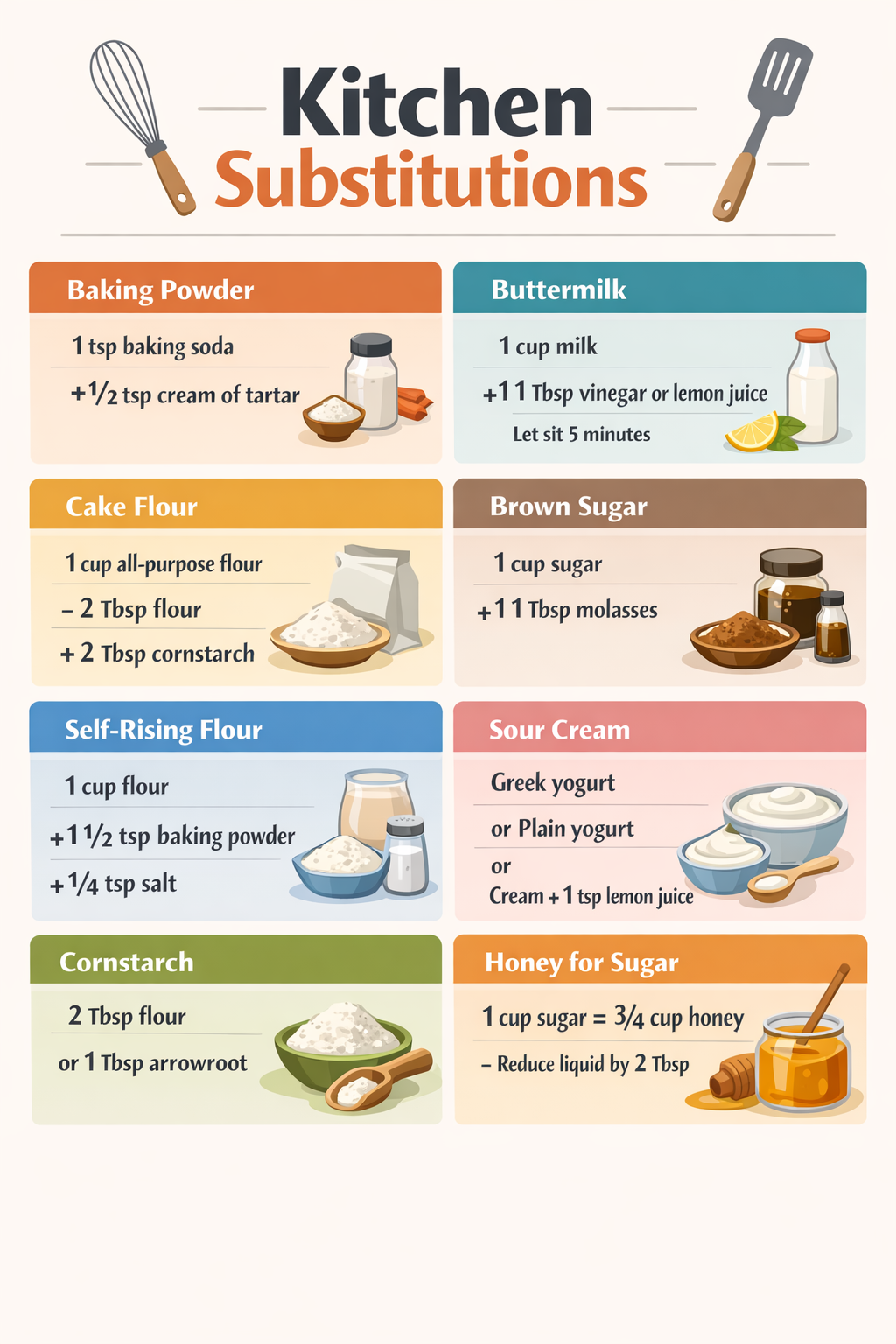
Baking Powder vs Baking Soda
These two get confused constantly, but they are not interchangeable.
Baking soda is pure sodium bicarbonate.
It needs acid to activate.
Think ingredients like:
- Buttermilk
- Yogurt
- Lemon juice
- Vinegar
- Brown sugar
- Cocoa powder (natural)
When baking soda meets acid + moisture + heat, it releases carbon dioxide bubbles that lift baked goods.
Baking powder, on the other hand, already contains acid.
It’s essentially baking soda + powdered acid + starch.
That means it works on its own.
If you need baking powder but only have baking soda:
For every 1 teaspoon baking powder, use:
- ¼ teaspoon baking soda
- ½ teaspoon cream of tartar
No cream of tartar? Add a small acidic ingredient like lemon juice or vinegar elsewhere in the recipe.
Buttermilk Substitute
Buttermilk is beloved in baking because it provides:
- Acidity (for tenderizing and activating baking soda)
- Moisture
- A subtle tang
But unless you make biscuits every weekend, most people don’t keep it around.
Easy substitute:
For 1 cup buttermilk combine:
- 1 cup milk
- 1 tablespoon vinegar or lemon juice
Let it sit 5 minutes until slightly thickened.
You now have a perfectly functional buttermilk substitute.
Plain yogurt thinned with milk also works beautifully.
Cake Flour Substitute
Cake flour produces incredibly soft cakes because it has lower protein content than all-purpose flour.
Less protein = less gluten development = softer crumb.
But cake flour isn’t always in the pantry.
Substitute for 1 cup cake flour:
- Measure 1 cup all-purpose flour
- Remove 2 tablespoons
- Add 2 tablespoons cornstarch
- Sift or whisk well
The cornstarch dilutes the protein level and mimics cake flour’s delicate structure.
Brown Sugar Substitute
Brown sugar is simply white sugar + molasses.
That’s it.
If your brown sugar has hardened into a brick (a common kitchen tragedy), you can make fresh brown sugar instantly.
For 1 cup brown sugar:
Mix:
- 1 cup granulated sugar
- 1 tablespoon molasses
Stir until evenly combined.
You can adjust the molasses for light or dark brown sugar.
Self-Rising Flour Substitute
Self-rising flour is just:
- Flour
- Baking powder
- Salt
To make 1 cup self-rising flour:
Combine:
- 1 cup all-purpose flour
- 1½ teaspoons baking powder
- ¼ teaspoon salt
This substitute is incredibly helpful for biscuits, pancakes, and quick breads.
Sour Cream Substitute
Sour cream brings richness, acidity, and moisture to recipes like cakes, sauces, and dips.
If you’re out, you have a few excellent options.
Best substitutes:
Greek yogurt – closest flavor and texture
Plain yogurt – slightly thinner but works well
Heavy cream + lemon juice – for sauces and soups
Each provides the same creamy tang recipes rely on.
Honey and Sugar Conversions
Honey is sweeter and more liquid than sugar, which means recipes need slight adjustments.
Substituting honey for sugar:
For 1 cup sugar, use:
- ¾ cup honey
- Reduce other liquid in recipe by about 2 tablespoons
Honey also browns faster, so baked goods may need slightly lower oven temperatures.
Cornstarch Substitute
Cornstarch is used primarily as a thickener.
If you don’t have it, several ingredients can step in.
Good substitutes:
All-purpose flour
Use 2 tablespoons flour for every 1 tablespoon cornstarch.
Arrowroot powder
Use 1:1 substitution and expect a glossy finish — great for sauces.
The Real Secret: Understanding Ingredients
Professional cooks rarely panic when they’re missing an ingredient.
They ask a different question:
What job is this ingredient doing?
Is it adding:
- Acid?
- Fat?
- Structure?
- Sweetness?
- Moisture?
- Leavening?
Once you understand that, substitutions become obvious instead of stressful.
And suddenly, your kitchen becomes a place where recipes are guides — not rules.
So the next time you discover you’re out of buttermilk, cake flour, or brown sugar halfway through a recipe…
Don’t panic.
Just cook like a chef.
 Brennah Van Wagoner
Weekly Newsletter Contributor since 2025
Email the author! brennah.oaks@gmail.com