
The Most Important Dessert You’ve Never Thought About
Hey chefs,
One of the biggest surprises I had in culinary school was realizing just how many classic desserts are actually variations of the same thing.
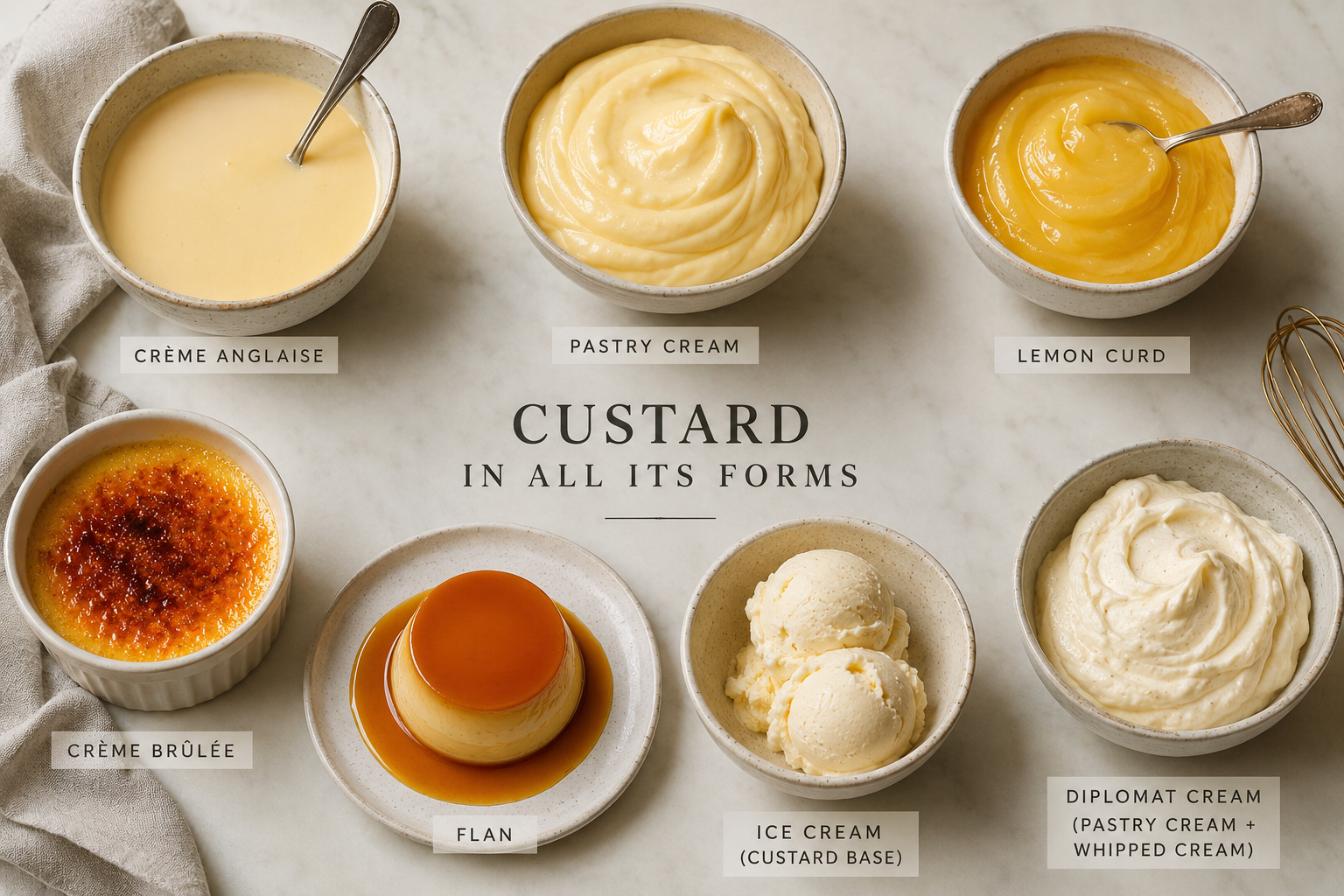
Crème brûlée, pastry cream, lemon curd, flan, ice cream, custard pie, diplomat cream, Bavarian cream—they all seem completely different when you first encounter them. They have different textures, different uses, and different appearances.
But beneath all those differences is the same fundamental idea.
They’re all descendants of custard.
Once you understand what custard is and how it works, suddenly half the pastry kitchen starts making sense.
What Is Custard?
At its core, custard is simply a liquid thickened by eggs.
That’s it.
When eggs are heated, the proteins inside them begin to unfold and connect to one another. Those proteins form a delicate network that traps water, fat, sugar, and air.
The stronger that network becomes, the thicker the custard becomes.
This is the foundation of countless desserts.
The fascinating part is that tiny changes to the formula can create dramatically different results.
A little more egg yolk gives you a richer custard.
A little starch gives you structure.
A little acid changes the entire flavor profile.
Add air and it becomes lighter.
Freeze it and it becomes ice cream.
The ingredients are often nearly identical. The techniques and ratios are what change everything.
Understanding the Custard Spectrum
I find it helpful to think of custards as existing on a spectrum.
On one end are pourable sauces.
On the other end are fully set desserts.
Everything else falls somewhere in between.
Crème Anglaise: The Starting Point
Crème anglaise is one of the simplest forms of custard.
It’s made from milk or cream, egg yolks, and sugar that are gently cooked together until slightly thickened.
The goal isn’t to create a pudding or filling. The goal is to create a sauce.
A properly made crème anglaise should coat the back of a spoon but still flow easily.
Key Technique
The challenge is controlling the heat.
Too cool and the eggs won’t thicken the mixture.
Too hot and you’ll end up with sweet scrambled eggs.
This is why crème anglaise is often considered one of the foundational pastry techniques. It teaches you how eggs behave under heat.
Common Uses
- Dessert sauces
- Ice cream bases
- Bread pudding bases
- Foundation for other custards
Pastry Cream: Custard with Structure
Pastry cream starts similarly but introduces an important new ingredient: starch.
Usually cornstarch.
Sometimes flour.
This seemingly small addition completely changes the texture.
The starch thickens the mixture and provides additional stability, allowing pastry cream to hold its shape inside pastries and cakes.
Key Technique
Unlike crème anglaise, pastry cream is usually brought to a brief boil.
The starch needs enough heat to fully gelatinize and develop its thickening power.
This creates a filling that is smooth, rich, and stable.
Common Uses
- Éclairs
- Cream puffs
- Fruit tarts
- Layer cakes
- Doughnuts
If crème anglaise is a sauce, pastry cream is a filling.
Lemon Curd: A Citrus Custard
Lemon curd often surprises people because it doesn’t look like what we traditionally think of as custard.
There’s no milk.
No cream.
Yet it’s still fundamentally built on the same principle.
Eggs are thickening a liquid.
The difference is that the liquid comes from citrus juice rather than dairy.
Key Technique
Lemon curd relies on careful cooking and constant stirring to prevent the eggs from scrambling.
Butter is added to create richness, improve mouthfeel, and give the curd its characteristic glossy finish.
Why Lemon Curd Works So Well
Lemon provides more than flavor.
Its acidity creates the bright, sharp character that makes curd so distinctive.
When creating curds with other fruits—such as blackberry, raspberry, mango, or passion fruit—you often still need some lemon or lime juice to maintain balance and acidity.
Without enough acidity, the result can taste flat or overly sweet.
Common Uses
- Tart fillings
- Cake fillings
- Scones
- Cookies
- Breakfast pastries
Crème Brûlée: A Baked Custard
Crème brûlée takes many of the same ingredients found in crème anglaise and simply changes the technique.
Instead of cooking the mixture on the stovetop until it thickens, it is baked gently until just set.
Key Technique
Most crème brûlées are baked in a water bath.
The water bath moderates the temperature and helps the custard cook evenly.
Custards prefer gentle heat. High temperatures can cause them to curdle, separate, or become grainy.
The ideal crème brûlée should still jiggle slightly when removed from the oven.
Common Uses
Mostly being eaten directly with a spoon—which honestly may be the best use of custard.
Flan: Another Baked Custard
Flan and crème brûlée are close relatives.
Both are baked custards.
Both rely primarily on eggs for thickening.
The biggest difference is the caramel.
With flan, caramel is cooked first and poured into the mold before the custard is added.
After baking and unmolding, that caramel becomes a beautiful sauce.
Key Technique
Making a properly caramelized sugar without burning it is often more challenging than the custard itself.
Texture
Typically a bit firmer than crème brûlée while still remaining creamy and smooth.
Ice Cream: Frozen Custard
Many traditional ice creams begin life as a custard.
A classic French-style ice cream base is essentially crème anglaise that has been chilled and churned.
Why Use Eggs?
Egg yolks contribute:
- Richness
- Smoothness
- Stability
- Better mouthfeel
The custard base helps prevent large ice crystals from forming, creating a creamier final product.
Key Technique
The custard must be fully chilled before churning.
Patience is one of the most important ingredients in good ice cream.
Diplomat Cream and Bavarian Cream
These are excellent examples of how pastry chefs continue building on the same foundation.
Diplomat cream is pastry cream folded with whipped cream.
Bavarian cream takes that idea further by incorporating gelatin for additional stability.
Both begin with pastry cream.
Both transform into something entirely different through the addition of air and structure.
Key Technique
Folding.
The goal is to preserve as much air as possible while maintaining a smooth, uniform mixture.
What Actually Changes Between All These Desserts?
When you compare them side by side, most differences come down to just a few variables.
Eggs
More eggs create a stronger structure.
Fewer eggs create a softer texture.
Starch
Starch creates stability and body.
This is what separates pastry cream from many traditional custards.
Fat
Cream, butter, and egg yolks all contribute richness and mouthfeel.
Acid
Acid creates brightness and dramatically changes flavor perception.
This is why lemon curd feels so different from pastry cream despite sharing many similarities.
Air
Whipped cream and foams create lighter textures.
Technique
The same ingredients can produce entirely different results depending on whether they are:
- Stirred
- Baked
- Chilled
- Frozen
- Folded
Technique matters just as much as ingredients.
The Takeaway
One of the most useful lessons I learned in pastry school was that these desserts aren’t really separate recipes.
They’re variations on a system.
Once you understand how eggs thicken liquids, how starch creates structure, how acid affects flavor, and how different cooking methods change texture, pastry starts feeling much less mysterious.
Instead of memorizing dozens of recipes, you begin recognizing patterns.
And once you recognize the patterns, creating your own variations becomes much easier.
Because whether you’re making crème brûlée, pastry cream, lemon curd, or ice cream, you’re really working with the same beautiful idea:
Custard in all its forms.
 Brennah Van Wagoner
Weekly Newsletter Contributor since 2025
Email the author! brennah.oaks@gmail.com