
Temperature Is an Ingredient
Hey chefs,
Recipes love to say things like:
Use room-temperature butter.
Bring the eggs to room temperature.
Let the cream cheese soften.
Allow the dough to come to room temperature.
And then they move on as though everyone has agreed on what “room temperature” means.
We have not.
Is room temperature 65°F? 72°F? Your kitchen in January? Your kitchen in August when the oven has been running for two hours?
More importantly, does it actually matter?
Sometimes, very much.
Other times, not nearly as much as recipes make it sound.
The real reason cooks care about ingredient temperature isn’t because 70°F is some magical culinary number. It’s because temperature changes the physical behavior of ingredients.
Butter becomes pliable.
Chocolate softens.
Egg yolks become more fluid.
Cream cheese blends instead of forming tiny lumps.
Yeast speeds up.
Fat melts.
Gluten relaxes.
And once you start thinking about temperature that way, “room temperature” becomes much easier to understand.
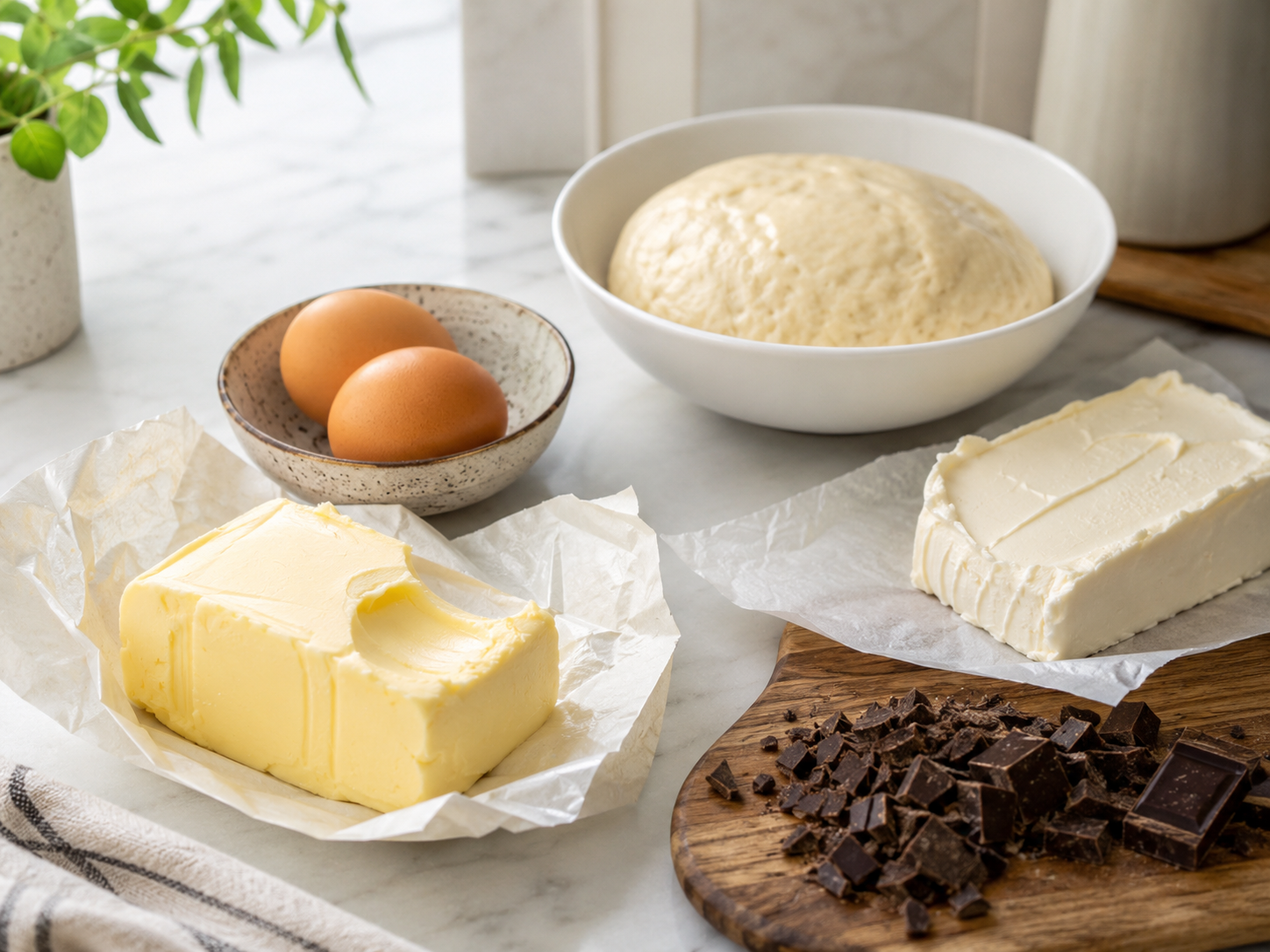
First: Room Temperature Isn’t Really a Temperature
In most recipes, “room temperature” is better understood as a texture or physical state than an exact number.
For many baking ingredients, we’re generally talking about somewhere around the upper 60s to low 70s°F.
But you usually don’t need to pull out a thermometer.
Instead, ask:
What does this ingredient need to be able to do?
Butter needs to bend and incorporate air without melting.
Cream cheese needs to blend smoothly.
Eggs need to combine easily with fat.
Bread dough may need to become warmer so fermentation can resume.
Chocolate may need to remain firm enough to handle cleanly.
Those are completely different jobs.
So let’s go ingredient by ingredient.
Butter: Soft Does Not Mean Melting
Butter is probably the ingredient most commonly misunderstood when a recipe calls for room temperature.
If you’re making cookies or cake using the creaming method, you want butter that is soft and pliable but still structurally solid.
Press it gently with a finger.
You should be able to make an indentation without the butter collapsing around your finger or looking greasy.
If the butter is shiny, oily, or partially melted, you’ve gone too far.
Why does this matter?
When butter and sugar are creamed together, sugar crystals carve tiny pockets into the softened butter. Those pockets trap air.
That air helps create lift and contributes to the texture of cakes and cookies.
If your butter is refrigerator-hard, it can’t expand and trap air efficiently.
If it’s half melted, it can’t hold those air pockets properly either.
So “room-temperature butter” really means:
Cool enough to hold its shape. Soft enough to whip.
In many kitchens, butter around roughly 65–68°F behaves beautifully for creaming.
That’s often slightly cooler than what people imagine when they hear “room temperature.”
Forgot to soften your butter?
Cut it into small cubes.
More surface area means it warms much faster.
You can also put the butter between pieces of parchment and gently pound or roll it thinner. Physically making the butter more flexible works surprisingly well.
What I don’t love is microwaving it aggressively.
Five seconds becomes ten seconds.
Ten seconds becomes one melted corner floating in a stick of cold butter.
We’ve all been there.
Eggs: Mostly About Emulsification
Room-temperature eggs matter most when you’re asking eggs to blend smoothly with fat.
Think cake batter.
Butter is mostly fat. Eggs contain quite a bit of water.
Fat and water are not naturally thrilled about becoming best friends.
Egg yolks contain emulsifiers—particularly lecithin—that help bring the mixture together.
When your butter, sugar, and eggs are relatively similar in temperature, that emulsion forms much more easily.
Add very cold eggs to properly softened butter and the butter can suddenly firm back up.
The batter may look curdled or broken.
It isn’t necessarily ruined, but you’ve made the process harder.
Room-temperature eggs also whip slightly more readily in applications where you’re trying to build volume.
Forgot to take the eggs out?
This is one of the easiest problems to solve.
Put the whole eggs in a bowl of warm—not hot—water for about 5 to 10 minutes.
Done.
No hour-long egg vigil required.
Cream Cheese: Temperature Is the Difference Between Silky and Lumpy
Anyone who has tried to beat refrigerator-cold cream cheese into frosting knows exactly why this one matters.
Cold cream cheese is firm.
Very firm.
If you try to combine it with soft butter, sugar, or other ingredients before it has softened, you can end up with tiny lumps that become frustratingly difficult to eliminate.
For cheesecake, frosting, dips, and creamy fillings, you generally want cream cheese that is soft enough to blend smoothly but not hot or melting.
Just like butter, the goal isn’t warmth for warmth’s sake.
The goal is compatible texture.
There’s another useful lesson here:
Ingredients that need to emulsify generally behave better when they’re close in temperature.
That applies to far more than cream cheese frosting.
It’s useful for cake batters, custards, buttercreams, ganache, sauces, and plenty of other mixtures.
Dairy: Sometimes Cold Is Fine. Sometimes It Causes Problems.
Milk and cream are another good example of why context matters.
If you’re making a cake with softened butter and the recipe specifically asks for room-temperature milk, pouring refrigerator-cold milk into the batter can firm the butter and interfere with the emulsion.
The batter may look grainy or curdled.
On the other hand, if you’re making whipped cream?
You want everything cold.
Cold cream holds onto its fat structure and whips much more effectively.
So the rule is not:
Warm dairy is better.
The rule is:
Use the temperature that supports the structure you’re trying to create.
That principle applies across the kitchen.
Dough: “Room Temperature” Depends on What You’re Trying to Make It Do
Dough temperature is especially interesting because dough changes dramatically as it warms.
Cold dough is firmer.
Butter solidifies.
Gluten becomes less extensible.
Yeast activity slows.
As dough warms, it becomes softer and more flexible, and yeast fermentation speeds up.
That means temperature is something bakers can deliberately manipulate.
Want cleaner shaping?
Chill the dough.
This is especially helpful with sticky enriched doughs, laminated doughs, babka, cinnamon rolls, and doughs containing lots of butter.
Want fermentation to move faster?
Warm the dough.
Want pizza dough to stretch more easily?
Give refrigerated dough time to warm and relax.
Cold gluten can feel tight and springy. As the dough rests, the gluten relaxes and becomes easier to stretch without snapping back.
This is why “let the dough sit at room temperature for 30 minutes” often isn’t really about bringing every molecule of dough to exactly 70°F.
It’s about changing its workability.
Chocolate: Room Temperature Can Mean the Difference Between Snappy and Smudgy
Chocolate brings yet another definition into the conversation.
Chocolate contains cocoa butter, and cocoa butter is extremely temperature sensitive.
Properly tempered chocolate is firm and glossy at a comfortable room temperature, then melts relatively quickly once it reaches body temperature.
That’s part of why good chocolate has that satisfying snap and then seems to disappear on your tongue.
But warm up your kitchen significantly and chocolate begins to soften.
This matters when you’re:
- chopping chocolate
- making decorations
- dipping candies
- rolling truffles
- shaping chocolate doughs
- handling chocolate garnishes
Sometimes the answer is not “bring the chocolate to room temperature.”
Sometimes the answer is exactly the opposite.
If your kitchen is hot and the chocolate is becoming soft and smeary, a short chill can make it much easier to work with.
Chocolate is a good reminder that your kitchen has seasons too.
A technique that works beautifully in February may behave very differently in August.
Meat: This One Needs a Myth Check
You’ve probably seen instructions telling you to take steaks, chops, or roasts out of the refrigerator and “bring them completely to room temperature before cooking.”
That advice gets repeated constantly.
But there are two important things to understand.
First, a thick piece of refrigerated meat does not magically become uniformly room temperature after sitting on the counter for 20 or 30 minutes. The surface warms considerably faster than the center.
Second, raw meat shouldn’t spend hours sitting around simply because you’re trying to achieve an arbitrary temperature.
For most steaks, chops, and chicken pieces, you don’t need to obsess about getting the center all the way to room temperature before cooking.
Instead, focus on things that have a bigger effect on the final result:
Dry the surface thoroughly.
Moisture has to evaporate before serious browning can happen.
Use appropriate heat.
Cook to internal temperature rather than relying only on time.
Account for carryover cooking.
Rest the meat appropriately after cooking.
A short time out of the refrigerator while you prepare the rest of dinner is perfectly normal.
Leaving raw meat on the counter for hours in pursuit of “room temperature” is not necessary.
Why Temperature Changes Browning
Temperature also determines how quickly food can begin browning.
Imagine putting a refrigerator-cold steak into a hot skillet.
Before parts of that surface can brown aggressively, energy must first heat the meat and evaporate surface moisture.
That’s one reason drying meat matters so much.
Water is extremely good at absorbing heat.
As long as there’s significant water sitting on the surface, much of your pan’s energy is being spent turning that water into steam instead of creating the deep brown crust you’re after.
The same principle applies to mushrooms, vegetables, scallops, potatoes, and plenty of other foods.
Warmth can help.
But dryness, pan temperature, and surface contact usually matter more.
Temperature Can Make an Emulsion Look Broken Even When the Recipe Is Correct
This is one of the most useful things to understand in baking.
Imagine you’re making a butter cake.
You perfectly cream your butter and sugar.
Then you add cold eggs.
Suddenly the mixture looks curdled.
You panic.
Was the butter bad?
Did you measure something wrong?
Did the baking gods abandon you?
Probably not.
The temperature simply changed.
Your softened butter partially solidified when the cold eggs were added, making the mixture look broken.
Sometimes gently warming the outside of the mixing bowl for a few seconds is enough to bring everything back together.
This is why professional kitchens pay attention not only to what ingredients go into a recipe, but also to their condition when they go in.
Temperature is part of the recipe.
Sometimes You Actually Want Ingredients Cold
“Room temperature” gets so much attention in baking that people sometimes start assuming warmer ingredients are always better.
Absolutely not.
There are plenty of times when cold is essential.
Pie dough
Cold butter helps create flaky pockets as it melts in the oven.
Biscuits and scones
Again, cold butter is your friend.
Whipped cream
Cold cream whips better and remains more stable.
Laminated dough
Croissants depend on keeping distinct layers of butter and dough. If the butter gets too warm and melts into the dough, you’ve lost the structure you’re trying to create.
Cookie dough
Chilling can firm fat, hydrate flour, reduce spreading, and change flavor development.
Filled breads
Cold dough often makes intricate shaping dramatically easier.
There is no universally “best” temperature.
There is only the temperature that gets you the result you want.
And Sometimes Warm Is the Goal
There are situations where a little warmth makes everything easier.
Yeasted dough ferments faster when it’s comfortably warm.
Butter spreads more easily.
Cream cheese blends smoothly.
Eggs incorporate more readily.
Bread dough becomes extensible.
Chocolate melts.
But there’s usually a threshold where helpful warmth turns into a problem.
Butter becomes greasy.
Chocolate loses its temper.
Whipped cream collapses.
Bread dough becomes sticky and difficult to shape.
Pie crust loses its flaky structure.
Cooking is often about staying on the useful side of that line.
The Bigger Lesson: Temperature Is an Ingredient
We tend to think of recipes as lists of ingredients plus instructions.
But temperature belongs on that list too.
Two cooks can use exactly the same quantities of flour, butter, eggs, sugar, and milk and end up with completely different cake batters because one started with refrigerator-cold ingredients and the other used properly softened ones.
The same steak behaves differently depending on whether its surface is wet or dry.
The same bread dough behaves differently at 40°F and 75°F.
The same butter can be solid, perfectly plastic, greasy, or completely liquid—all without changing a single ingredient.
That’s why I think “bring to room temperature” is actually less useful than asking one question:
What texture does this ingredient need to have for the next step to work?
Butter needs to be pliable.
Cream cheese needs to be smooth.
Eggs need to incorporate.
Dough may need to relax.
Chocolate may need to stay firm.
Once you understand the job, you don’t have to blindly follow the phrase “room temperature.”
You can look at the ingredient and know when it’s ready.
And that is much more useful than waiting 45 minutes because a recipe told you to.
 Brennah Van Wagoner
Weekly Newsletter Contributor since 2025
Email the author! brennah.oaks@gmail.com