
A Chef’s Guide to Campfire Snacks
Hey chefs,
I may have gone to culinary school, but I still believe some of the best summer food involves putting candy on a stick and holding it near a fire.
Good cooking does not always have to be polished, complicated, or especially sophisticated. Sometimes it means using what you know about heat, browning, melting, and texture to make an exceptionally good marshmallow. Sometimes it means roasting a Starburst just to see what happens.
Campfire cooking has its own kind of magic. The equipment is minimal, the heat is unpredictable, and at least one thing will probably fall into the fire. That is part of the fun.
S’mores will always be the classic, but they are only the beginning. Toaster pastries, fruit chews, cinnamon rolls, sandwich cookies, fruit, soft pretzels, and even cheese can all become wonderfully gooey, caramelized, crisp, or slightly chaotic around a campfire.
Here is how to roast them well—using just enough cooking technique to make everything more delicious without taking the fun out of it.
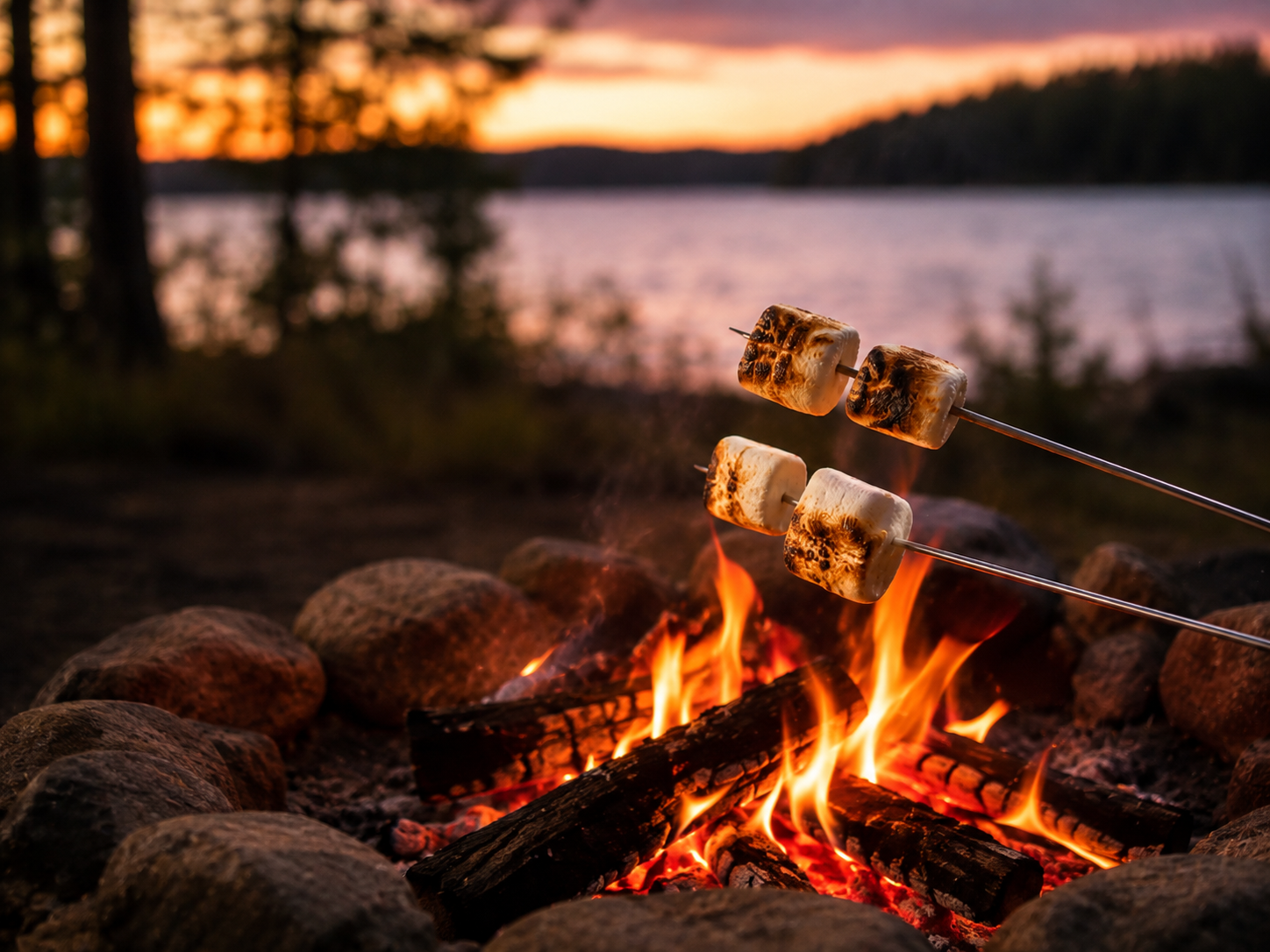
First, Build a Better Roasting Fire
The biggest campfire-snack mistake is cooking everything directly in tall, aggressive flames.
Flames are dramatic, but they are inconsistent. They scorch the exterior of food before the center has time to warm. This is how you end up with a marshmallow that is black on the outside, cold in the middle, and actively on fire.
Most campfire cooking works better over glowing coals.
Allow the fire to burn long enough to create a hot, even layer of embers. You can keep a few logs burning off to one side for warmth and ambiance, but use the gentler radiant heat near the coals for most of your snacks.
Think of the fire as having a few different heat zones:
- Directly over the brightest coals: High heat for quick blistering and browning.
- Near the edge of the fire: Moderate heat for warming, melting, and slow toasting.
- On a grill grate above the coals: Best for foil packets, pastries, fruit, and anything too delicate for a skewer.
Long metal roasting forks are the most reliable tools, but sturdy wooden skewers can also work. Soak thin wooden skewers in water first to help prevent burning.
Be careful about using sticks gathered near the campsite. Avoid anything painted, treated, moldy, covered in sap, or from a plant you cannot identify.
Now that we have established a respectable heat zone, it is time to start roasting increasingly questionable things.
The Perfect Campfire Marshmallow
A beautifully toasted marshmallow should be deeply golden on the outside and completely molten inside.
Hold it several inches above the coals rather than directly in the flames. Rotate it slowly and continuously, almost like a tiny marshmallow rotisserie. The exterior will gradually dry, puff, and turn golden while the center becomes warm and stretchy.
This takes longer than setting it on fire, but the texture is dramatically better.
Of course, deliberately lighting a marshmallow on fire and blowing it out is also a beloved campfire tradition. I am a chef, not the marshmallow police.
For an especially gooey s’more, place the chocolate on one of the graham crackers and set it near the edge of the fire for a minute before assembling. Slightly warming the chocolate helps it melt into the marshmallow instead of remaining one stubborn, solid square.
You can also wrap the assembled s’more loosely in foil and warm it near the coals for 30 to 60 seconds. This turns the entire thing into one cohesive, melted dessert—but watch it carefully, because graham crackers scorch quickly.
Upgrade the Classic S’more
The original combination of graham crackers, chocolate, and toasted marshmallow is already perfect. It does not need fixing.
That does not mean we cannot play with it.
Try replacing the chocolate bar with:
- Peanut butter cups
- Caramel-filled chocolate
- Peppermint patties
- Cookies-and-cream chocolate
- Dark chocolate with sea salt
- Chocolate hazelnut spread
- Cookie butter
- Dulce de leche
- A thin layer of peanut butter
You can also replace the graham crackers with chocolate sandwich cookies, shortbread, waffle cookies, chocolate chip cookies, or thin ginger cookies.
For an easy fruit variation, add a few thin slices of strawberry, banana, peach, or raspberry before pressing the s’more together. The fruit adds freshness and acidity, which keeps the dessert from tasting overwhelmingly sweet.
Campfire Toaster Strudel
Toaster Strudel around a campfire sounds chaotic because it is chaotic—but it is also delicious.
Do not attempt to spear a frozen pastry directly onto a stick. As it heats, the pastry will soften, collapse, and make a heroic leap into the fire.
Instead, lightly grease a piece of heavy-duty foil and place the pastry in the center. Fold the foil loosely around it, leaving a little room for air to circulate. Set the packet on a grill grate over medium coals, turning it occasionally, until the pastry is hot and crisp around the edges.
You can also warm it in a small cast-iron skillet.
Wait to add the icing until the pastry comes off the fire. Drizzle it over the hot strudel and let it melt into the flaky layers.
For an even more excessive version, split the warm pastry open and tuck a toasted marshmallow inside. It is sticky, messy, and completely impractical—which is usually a sign that a campfire dessert is going well.
This method also works with most frozen toaster pastries, hand pies, and turnovers. Keep the heat moderate so the filling has time to warm before the exterior burns.
Roasted Starburst
Roasted Starburst may sound like something invented during a sugar-fueled camping trip, but warming the candy completely changes its texture.
Unwrap the Starburst, slide it onto a metal skewer, and hold it near the edge of the coals. Rotate it constantly for only a few seconds.
The exterior will soften and become slightly glossy while the center turns warm and chewy. With a little more heat, the edges may begin to lightly caramelize.
Starburst go from pleasantly softened to molten very quickly, so let them cool before eating. Melted fruit candy is extremely hot and can stick to skin.
You can roast one flavor at a time or stack several flavors on the skewer. Pink and red create a mixed-berry flavor, while orange and yellow taste like warm citrus candy.
This technique can also work with other firm, individually wrapped fruit chews, although different candies may soften at different speeds.
Cinnamon Rolls on a Stick
Refrigerated cinnamon-roll dough is one of the best campfire shortcuts.
Instead of leaving each roll intact, unwind the dough into a long strip and wrap it in a spiral around a thick, clean roasting stick or metal skewer. Leave a little space between the coils so the dough can expand and cook more evenly.
Hold it over moderate coals and rotate it slowly until the exterior is browned and the dough feels firm rather than soft and squishy.
This requires patience. If the heat is too high, the cinnamon sugar will burn while the dough inside remains raw.
Once cooked, slide the cinnamon roll off the stick and drizzle it with the packaged icing. You can also dip it in melted chocolate, caramel sauce, or cinnamon sugar.
For a savory version, wrap crescent-roll dough around the skewer and serve it with warm marinara or cheese sauce.
Campfire Croissants and Crescent Dough
Refrigerated crescent dough is essentially edible campfire craft material.
Wrap strips around a roasting stick and cook them slowly, just as you would cinnamon-roll dough. Once baked, the hollow center can be filled with chocolate spread, jam, lemon curd, peanut butter, or toasted marshmallow.
You can also wrap the dough around a piece of chocolate before cooking, although it is safest to secure the packet in foil or cook it inside a pie iron so the filling does not escape into the fire.
For something savory, wrap the dough around a hot dog, fully cooked sausage, or cheese stick.
Use precooked meat for this kind of snack. Campfire heat can be inconsistent, so it is difficult to ensure raw sausage cooks safely inside a layer of dough before the outside burns.
Roasted Fruit
Fruit may sound suspiciously nutritious next to a flaming marshmallow, but fire does wonderful things to natural sugar.
Peaches and Nectarines
Cut the fruit in half, remove the pits, and place it cut-side down on a lightly greased grate. Cook until the surface is caramelized and the fruit begins to soften.
Fill the centers with brown sugar, cinnamon, crushed graham crackers, or a piece of chocolate.
Pineapple
Pineapple is sturdy enough to place directly on a skewer. Roast the chunks over the coals until their edges darken and the juice begins to bubble.
A sprinkle of cinnamon sugar or chili-lime seasoning makes it even better.
Bananas
Leave the banana inside its peel and slice it lengthwise without cutting all the way through. Stuff the opening with chocolate chips, mini marshmallows, peanut butter chips, caramel pieces, or crushed cookies.
Wrap the banana in foil and place it near the coals until the fruit is soft and the fillings have melted. Eat it directly from the peel with a spoon.
Apples
Thin apple slices can be skewered and roasted, but whole apples take quite a while to soften.
For an easier dessert, place chopped apples in a foil packet with butter, brown sugar, cinnamon, and a pinch of salt. Cook over the coals until tender.
Add crushed graham crackers or granola just before serving for a simple campfire apple crisp.
Roasted Sandwich Cookies
Chocolate sandwich cookies become surprisingly good when warmed.
The cookies soften slightly, the filling loosens, and the chocolate aroma becomes more pronounced. Slide the cookie carefully onto a two-pronged roasting fork and warm it near the coals for just a few seconds on each side.
You are not trying to char it. You only want to heat the center.
For maximum campfire excess, gently separate the warm cookie, add a toasted marshmallow, and sandwich it back together.
Peanut butter sandwich cookies, vanilla sandwich cookies, and chocolate-covered cookies can also be warmed. Anything coated in chocolate will melt very quickly, so handle it carefully.
Campfire Pretzels and Cheese
Not every campfire snack needs to be sweet.
Soft pretzels warm beautifully over a grate or inside a foil packet. Brush them with melted butter after heating and sprinkle them with coarse salt, cinnamon sugar, ranch seasoning, or Parmesan.
For a simple cheese snack, place cubes of a firm grilling cheese such as halloumi on a metal skewer and toast them over the coals. Halloumi holds its shape especially well and develops a browned, salty crust.
You can also make a miniature campfire grilled cheese using a pie iron. Butter the outside of two slices of bread, add cheese, close the iron, and cook it over the coals, flipping frequently.
Let the sandwich rest before biting into it. Campfire cheese has no respect for the roof of your mouth.
Popcorn Over the Fire
Popcorn is possible over a campfire, but it needs to be enclosed.
Place popcorn kernels and a small amount of neutral oil inside a heavy-duty foil pouch, leaving plenty of room for expansion. Seal the edges tightly and place the pouch on a grate above the coals.
Move or shake it frequently as the packet heats. Once the popping slows, remove it immediately.
Open the pouch away from your face because hot steam will escape. Season the popcorn with melted butter, salt, cinnamon sugar, cheese powder, or smoky spices.
A lidded campfire-safe pot with a long handle is even easier and more reliable.
Campfire Cones
Campfire cones are essentially s’mores for people who want more filling and less structural integrity.
Fill a waffle cone with any combination of:
- Mini marshmallows
- Chocolate chips
- Peanut butter chips
- Chopped candy bars
- Banana slices
- Berries
- Caramel pieces
- Crushed cookies
Wrap the cone in foil and place it over moderate coals, turning occasionally, until the fillings are warm and melted.
Allow it to cool briefly before opening. The chocolate will be molten, and any fruit inside may release hot steam.
Campfire Snack Rules Worth Following
Campfire snacks are supposed to be relaxed, but a few guidelines make the experience safer and much more delicious.
Keep raw and ready-to-eat foods separate. Do not use the same fork for raw meat and marshmallows unless it has been thoroughly washed.
Use heat-resistant gloves or long tongs when moving foil packets. Foil may look harmless, but it becomes extremely hot.
Be especially careful with melted sugar. Marshmallows, caramel, jam, and fruit candy can all stick to skin and cause burns. Give everything a moment to cool before eating.
Never throw plastic, candy wrappers, or foil into the fire. Pack out everything you bring in.
And do not walk or run while carrying roasting sticks. This may be the least glamorous culinary advice I ever give you, but it is important.
Knowing More About Food Should Make It More Fun
One of my favorite things about learning to cook professionally is realizing that technique does not have to make food serious.
Understanding heat helps us toast a marshmallow more evenly. Knowing how sugar behaves helps us caramelize fruit without scorching it. Recognizing the difference between tall flames and glowing coals can turn a frozen toaster pastry into a genuinely good campfire dessert.
But the goal is not to make every outdoor snack elegant.
Sometimes the goal is to roast a Starburst, drop half a marshmallow into the dirt, laugh about it, and make another one.
Summer is short. Build the fire, gather the snacks, and roast something wonderfully unnecessary.
 Brennah Van Wagoner
Weekly Newsletter Contributor since 2025
Email the author! brennah.oaks@gmail.com