
Beyond American Buttercream: A Master Class in Frosting
Hey chefs,
I cannot tell you how many times I’ve heard someone say:
“I don’t like buttercream.”
And every time I want to gently place a hand on their shoulder and say,
“Oh friend. Which one?”
Because here’s the thing:
There isn’t one buttercream.
If someone says, “I don’t like buttercream,” what they usually mean is:
“I once had a grocery store cupcake that tasted like straight powdered sugar.”
That’s not buttercream’s fault.
There are multiple classic styles — each with different sweetness levels, textures, techniques, and uses.
If your only experience with frosting is a stiff, ultra-sweet grocery store cupcake… you’ve barely scratched the surface.
Let’s expand your frosting horizon
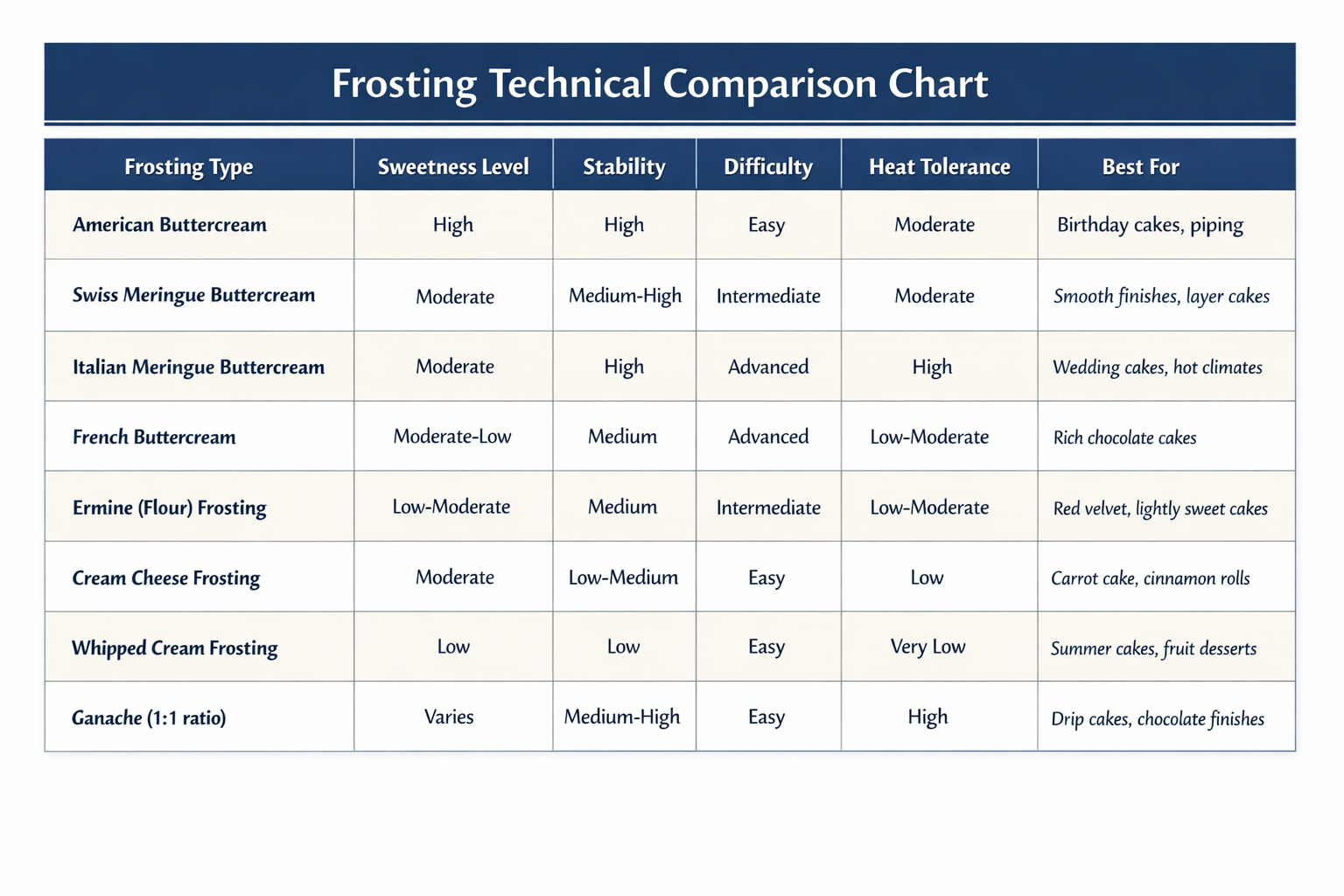
1. American Buttercream
(The Simplest. The Sweetest. The Most Misunderstood.)
Technique
This is a fat-based frosting, not an emulsion.
You cream room-temperature butter until light and aerated. Then powdered sugar is added gradually. The cornstarch in powdered sugar actually helps stabilize it.
A splash of cream loosens it. Vanilla and salt balance it.
That’s it.
No heat. No eggs. No syrup stages.
Texture & Flavor
- Dense and pipeable
- Slight crust on the outside (due to sugar concentration drying)
- Very sweet
- Pure butter-forward vanilla
If properly whipped, it becomes surprisingly fluffy — almost like sweetened butter mousse.
Why It Fails So Often
- Butter too cold → gritty
- Butter too warm → greasy
- No salt → one-note sweetness
- Cheap vanilla → artificial flavor
Pro move: Whip for a full 5–7 minutes. Incorporate air. Finish with flaky salt.
American buttercream is bold. It’s unapologetically sweet. It’s not subtle — and that’s okay.
2. Swiss Meringue Buttercream
(Silk in Edible Form)
Technique
This is an egg-white-based emulsion.
- Egg whites + sugar are heated over a bain-marie to about 160°F.
(You’re dissolving sugar and denaturing proteins.) - The mixture is whipped into a glossy meringue until cool.
- Room-temperature butter is added slowly.
At this stage, it may:
- Look curdled
- Look soupy
- Make you question your life choices
Keep mixing.
Eventually, the water (from egg whites) and fat (butter) emulsify.
And then it transforms.
Texture & Flavor
- Silky
- Buttery without being heavy
- Light sweetness
- Smooth melt
It spreads like satin paint. It doesn’t crust. It feels refined.
Swiss is quiet confidence frosting.
3. Italian Meringue Buttercream
(The Toasted Marshmallow Dream)
This is one of my all time favorites
Italian buttercream tastes like a warm, melty, gooey marshmallow and I cannot get enough of it.
Technique
Instead of heating the whites with sugar, you:
- Whip egg whites to soft peaks.
- Cook sugar + water to 240°F (soft-ball stage).
- Stream the hot syrup into the whipping whites.
The syrup partially cooks the whites and stabilizes the structure instantly.
Then butter is added once the mixture cools.
Because the sugar was cooked, you get a subtle caramelized depth — that faint toasted note you’ll taste.
Texture & Flavor
- Glossy
- Slightly denser than Swiss
- Exceptionally smooth
- Subtle marshmallow undertone
It’s incredibly stable.
This is the frosting that holds up in wedding cakes and outdoor events.
It feels luxurious but strong.
Italian buttercream is the overachiever of frostings.
4. French Buttercream
(The Custard Lover’s Frosting)
Technique
Instead of egg whites, we use yolks.
- Whip egg yolks until thick and pale.
- Cook sugar syrup to 240°F.
- Stream syrup into yolks while whipping.
- Add butter.
The yolks bring fat and lecithin — a powerful emulsifier.
Texture & Flavor
- Rich golden color
- Deep custard flavor
- Slightly eggy (in a crème anglaise way)
- Silky but heavier
This frosting tastes like pastry cream met butter and decided to live its best life.
It pairs beautifully with:
- Chocolate
- Espresso
- Hazelnut
- Dark rum
French buttercream is decadent. It’s not for vanilla birthday cakes. It’s for layered opera cakes and adult desserts.
5. Ermine Frosting
(The Vintage Revival)
This one surprises everyone.
Technique
You cook flour and milk together until thick — like pudding.
This gelatinizes the starches.
You cool it completely.
Then you whip butter and sugar separately, and incorporate the cooled paste.
The flour paste creates structure without overwhelming sweetness.
Texture & Flavor
- Extremely light
- Not grainy
- Mild sweetness
- Clean vanilla profile
It feels almost whipped-cream-light but with butter stability.
Historically, this was the original red velvet frosting.
It tastes nostalgic. Soft. Balanced.
6. Cream Cheese Frosting
(The Tang That Changed Everything)
Technique
It’s a simple creamed frosting — but temperature matters.
Cream cheese must be cool, not overly soft.
Butter must be soft but not greasy.
Beat cream cheese first to remove lumps. Then butter. Then sugar.
Overmixing can cause looseness.
Texture & Flavor
- Tangy
- Soft
- Slightly looser structure
- Creamy mouthfeel
It balances sweet cakes beautifully.
The acidity makes it addictive.
7. Whipped Cream Frosting
(Air in Its Most Delicious Form)
Technique
Cold cream. Cold bowl. Cold whisk.
Whip to soft peaks.
Sugar is added near the end to avoid deflation.
To stabilize you can add:
- Gelatin
- Mascarpone
- Cream cheese
Texture & Flavor
- Featherlight
- Milky
- Clean
- Not overly sweet
It’s ephemeral. It must be refrigerated.
But nothing tastes fresher on a summer berry cake.
8. Ganache
(Not Technically Frosting… But Yes It Is)
Technique
Hot cream poured over chocolate.
Let sit. Stir gently.
The ratio determines texture:
- 1:1 → glaze
- 2:1 chocolate to cream → spreadable
- Whipped → mousse-like
Texture & Flavor
- Deep chocolate
- Glossy
- Smooth
- Luxurious mouthfeel
Ganache feels professional. Intentional. Polished.
So Here’s the Real Question
Do you hate buttercream?
Or have you just never met the right one?
Each frosting carries:
- A different sugar method
- A different protein structure
- A different emulsification
- A different sweetness level
Buttercream isn’t one thing.
It’s a category of technique.
And once you understand it, you don’t just frost cakes.
You design texture.
You engineer sweetness.
You build balance.
That’s when baking shifts from “recipe following” to craft.
Stay silky, chefs.
 Brennah Van Wagoner
Weekly Newsletter Contributor since 2025
Email the author! brennah.oaks@gmail.com