
Irish Soda Bread: A Bread So Good It Doesn’t Need a Holiday to Promote It!
There’s a strong school of thought that says “What would St. Patrick’s Day be without Irish soda bread?” Being a Swede, I’ve never thought about it. Which is why I missed writing about this in time for your St. Patrick’s Day dinner. But better late than never, right?
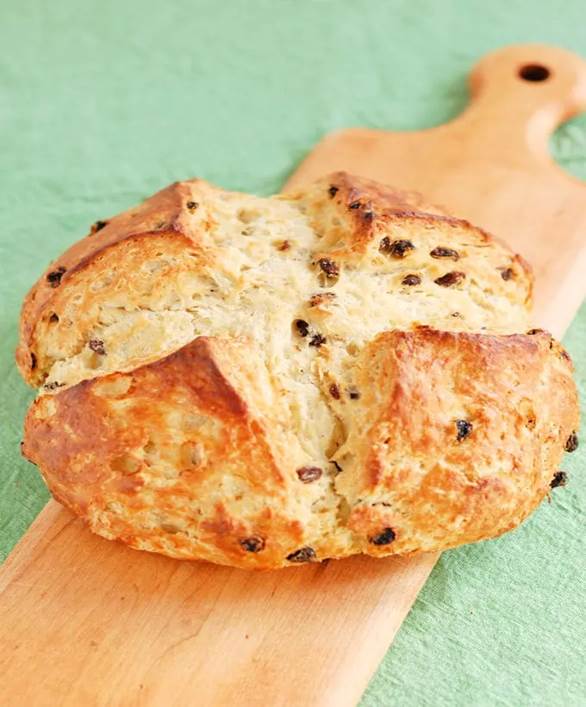
So let’s talk about it now, because there are some good reasons why the Irish like it so much. First of all, it’s a “quick bread.” Quick breads get their lift from a chemical leavener (in this case, baking soda, as its name implies) rather than yeast. As soon as the bread is mixed it’s ready to bake.
Baking expert, Eileen of www.baking-sense.com, says that with no yeast or fussy fermentation, no rolling or cutting, soda bread is even easier to make than muffins or biscuits. (I’m liking this concept!)

If the idea of making this easy bread appeals to you, then here are some important tips Eileen shares for making this time-honored treat:
· Mixing by hand helps ensure that you won’t over work and toughen the dough.
· The dough can be a little sticky. If your hands get coated with the sticky dough don’t try to wash it off with water, it’ll just get stickier and leave a mess in the sink. Dip your hands into the flour bin to coat them. Holding your hands over the trash can, rub them together vigorously and the sticky dough will come off easily.
· Cutting a deep X in the top of the loaf before it goes in the oven ensures that it will rise evenly without splitting in random places.
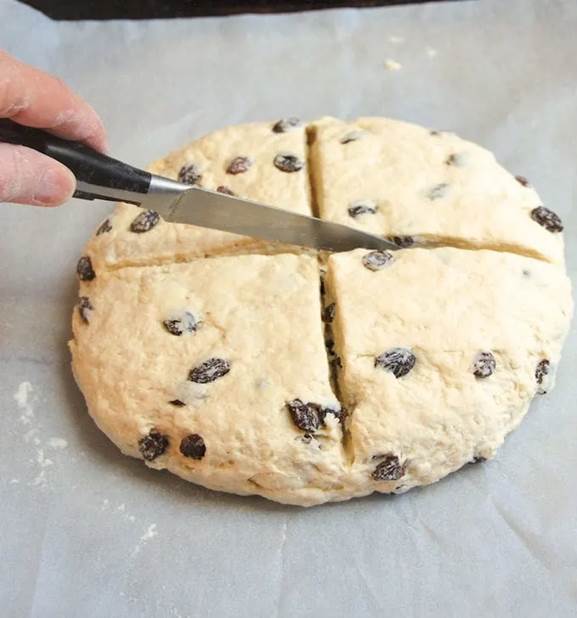
· Raisins are optional but highly recommended.
· If the raisins on the surface of the dough burn in the oven, just pick them off (careful, they’re hot) when the bread comes out of the oven.
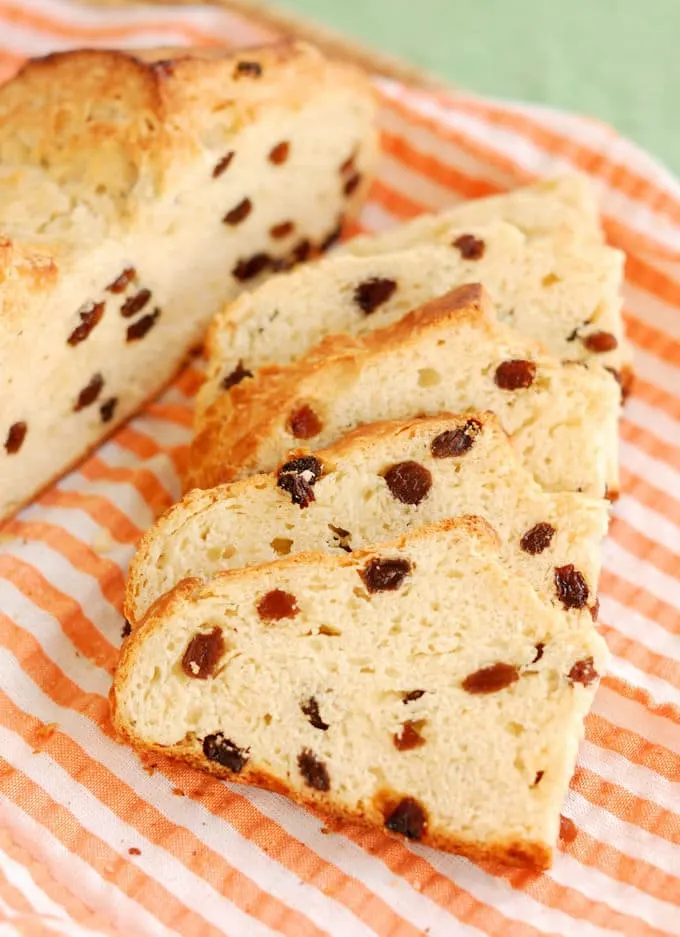
· And while this bread is best eaten the day of baking, it will keep several days at room temperature. It also stores well in the freezer for 1-2 months.
I’ll close with Eileen’s favorite Irish soda bread recipe. Her reviewers all agree that this tastes much better than any store-bought version. This sounds like a terrific bread, whether its promotional holiday is past or not! (And if you’re already familiar with it, tell us why you like it or share your baking tips—we’d love to hear from you.)
Traditional Irish Soda Bread
4 cups unbleached all-purpose flour (see note)
1 teaspoon salt
2 tablespoons sugar
1 1/2 teaspoons baking powder
1/2 teaspoon baking soda
3 tablespoons unsalted butter (room temperature)
1 cup raisins
2 cups buttermilk
Directions:
Sift or whisk together 20 ounces unbleached all purpose flour, 1 teaspoon table salt, 1 ounce granulated sugar, 1 ½ teaspoons baking powder and ½ teaspoon baking soda. Use your hands to work 1 ½ ounces unsalted butter into the dry ingredients until there are no pieces larger than the size of a pea. Toss 6 ounces raisins with the dry ingredients.
Add 16 ounces buttermilk all at once and mix until the dry ingredients are almost incorporated. The dough may seem dry at this point but it will come together.
Turn the dough onto a floured surface and knead about 15-20 times to form a smooth ball. Place the loaf onto the prepared baking sheet. Use your hands to flatten the ball slightly. Use a sharp knife to cut a 1/2?-3/4? deep X into the top of the loaf. Brush the loaf with buttermilk.
Bake until the loaf sounds hollow when tapped on the bottom or the middle of the loaf is about 200 °F, 45 minutes to an hour.
NOTES
If measuring the flour by volume use the “dip & sweep” method. That is, dip the measuring cup into the flour bin, overfill it, then sweep away the excess.
This recipe makes one large or two smaller loaves. If you split the dough into two smaller loaves adjust the baking time accordingly. The recipe can also be halved to make one smaller loaf.
Recipe formatted with the Cook'n Recipe Software from DVO Enterprises.
 Alice Osborne
Weekly Newsletter Contributor since 2006
Email the author! alice@dvo.com