
Stop Memorizing Recipes. Start Understanding Baking.
Hey chefs,
One of the biggest mindset shifts I had in culinary school—especially in baking—was realizing that recipes aren’t rules. They’re formulas.
Baking formulas describe how ingredients relate to each other by weight, and those relationships determine everything: crumb, moisture, tenderness, rise, and shelf life. Once you understand the ratios behind a recipe, you’re no longer locked into it—you can read it, adjust it, and even build your own.
Let’s start with how to read these formulas, then we’ll look at what they mean for cakes and breads.
How to Read Baking Ratios (The Language of Formulas)
When you see a ratio like 1:1:1:1, it means equal weights of each ingredient listed—in the order given.
So if the formula is:
- Flour : fat : sugar : eggs
- And the ratio is 1:1:1:1
That could look like:
- 200g flour
- 200g butter
- 200g sugar
- 200g eggs
Now here’s the important part:
The numbers don’t represent amounts—they represent relationships.
What About Unequal Ratios?
Let’s say a cake formula is written as 1:2:1:1 (flour : sugar : fat : eggs).
That means:
- Sugar weighs twice as much as the flour
- Fat and eggs weigh the same as the flour
So if you start with:
- 200g flour
Then the rest becomes: - 400g sugar
- 200g fat
- 200g eggs
That one change—doubling the sugar—completely alters the cake’s structure, tenderness, moisture, and browning.
This is why understanding ratios matters more than memorizing recipes.
Cake Formulas
(Why some cakes are fluffy, some are rich, and some soak up syrup)
1. High-Ratio Cakes

Typical ratio structure:
- Flour : sugar = 1 : 1.25–1.5
- Fat ≈ eggs
- Additional liquid as needed
In plain terms:
There is more sugar than flour.
What that does structurally:
Sugar is hygroscopic—it attracts and holds moisture. When sugar outweighs flour:
- Gluten development is limited
- The crumb becomes very fine and tender
- The cake stays moist longer
Fat (usually butter) is creamed with sugar, trapping air that helps with lift and even texture.
The result:
- Soft, fluffy crumb
- Even rise
- Excellent for layer cakes and cupcakes
- Stays tender for days
If a cake feels plush and bakery-style, it’s almost always a high-ratio formula.
2. Pound Cake–Style Formulas
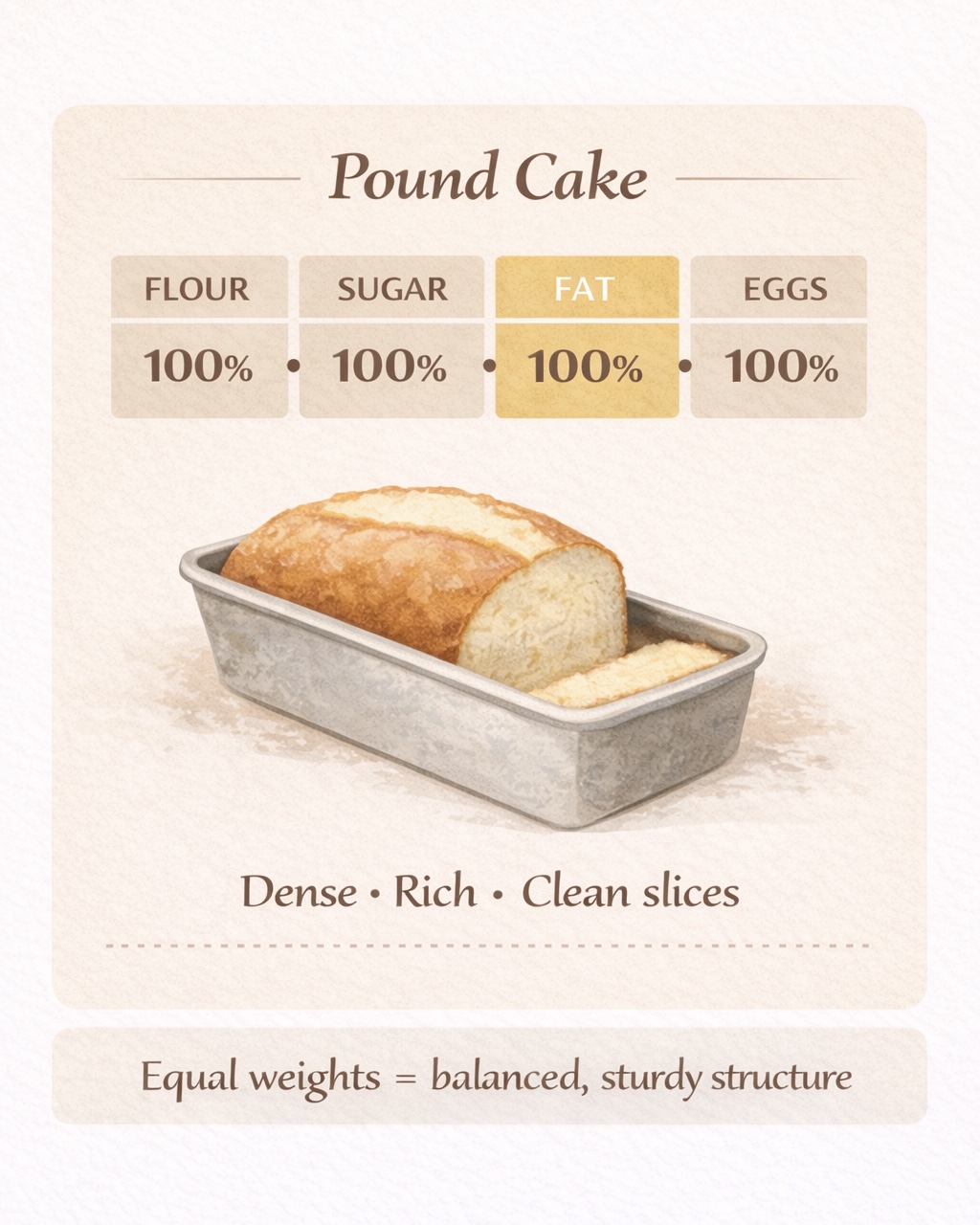
Classic ratio:
- Flour : butter : sugar : eggs = 1 : 1 : 1 : 1
What that actually means:
Each ingredient weighs the same, so no single element dominates.
What this does structurally:
- Less sugar = less tenderizing
- Less liquid = tighter crumb
- Eggs and fat provide richness and structure
These cakes rely more on eggs than air for structure, which is why they’re dense but not dry.
The result:
- Rich, buttery texture
- Tight but tender crumb
- Slices cleanly
- Feels substantial rather than airy
This is the formula behind loaf cakes and tea cakes that feel “classic” and sturdy.
3. Reduced-Sugar or Rustic Cakes

Example ratio:
- Flour : sugar : fat : eggs = 1 : 0.75 : 0.75 : 1
What this means:
Sugar and fat weigh less than the flour.
What this does structurally:
With less sugar and fat:
- Gluten develops more
- The crumb becomes firmer
- Moisture retention decreases
These cakes feel less plush but more bread-like and sturdy.
The result:
- Less sweet
- Slightly drier crumb
- Good for fruit-heavy cakes or rustic desserts
- Often paired with glazes or syrups
If a cake feels “snack-y” or breakfast-appropriate, this is often why.
4. Foam Cakes (Egg-Driven Structure)

Ratio focus:
- Eggs dominate the formula
- Sugar stabilizes
- Minimal fat
- Light flour added carefully
What this does structurally:
Eggs trap air when whipped. Sugar strengthens that foam, and flour sets it in the oven. Fat is minimized because it collapses foam.
The result:
- Very light texture
- Flexible layers
- Less rich on their own
- Excellent at absorbing syrups
These cakes feel dry alone but luxurious once soaked and layered.
Bread Formulas
(How ratios affect chew, softness, and crumb)
Understanding Hydration First
Bread ratios usually reference hydration, which compares water to flour.
A 70% hydration dough means:
- 1000g flour
- 700g water
That single number changes everything.
1. Lean Doughs

Basic ratio:
- Flour : water = 1 : 0.6–0.75
- Plus yeast and salt
What this does structurally:
Water hydrates flour proteins, allowing gluten to form strong networks. With no fat or sugar to interfere, gluten develops fully.
The result:
- Chewy interior
- Crisp crust
- Open crumb at higher hydration
- Strong wheat flavor
This is why baguettes and rustic loaves feel hearty rather than soft.
2. Enriched Doughs
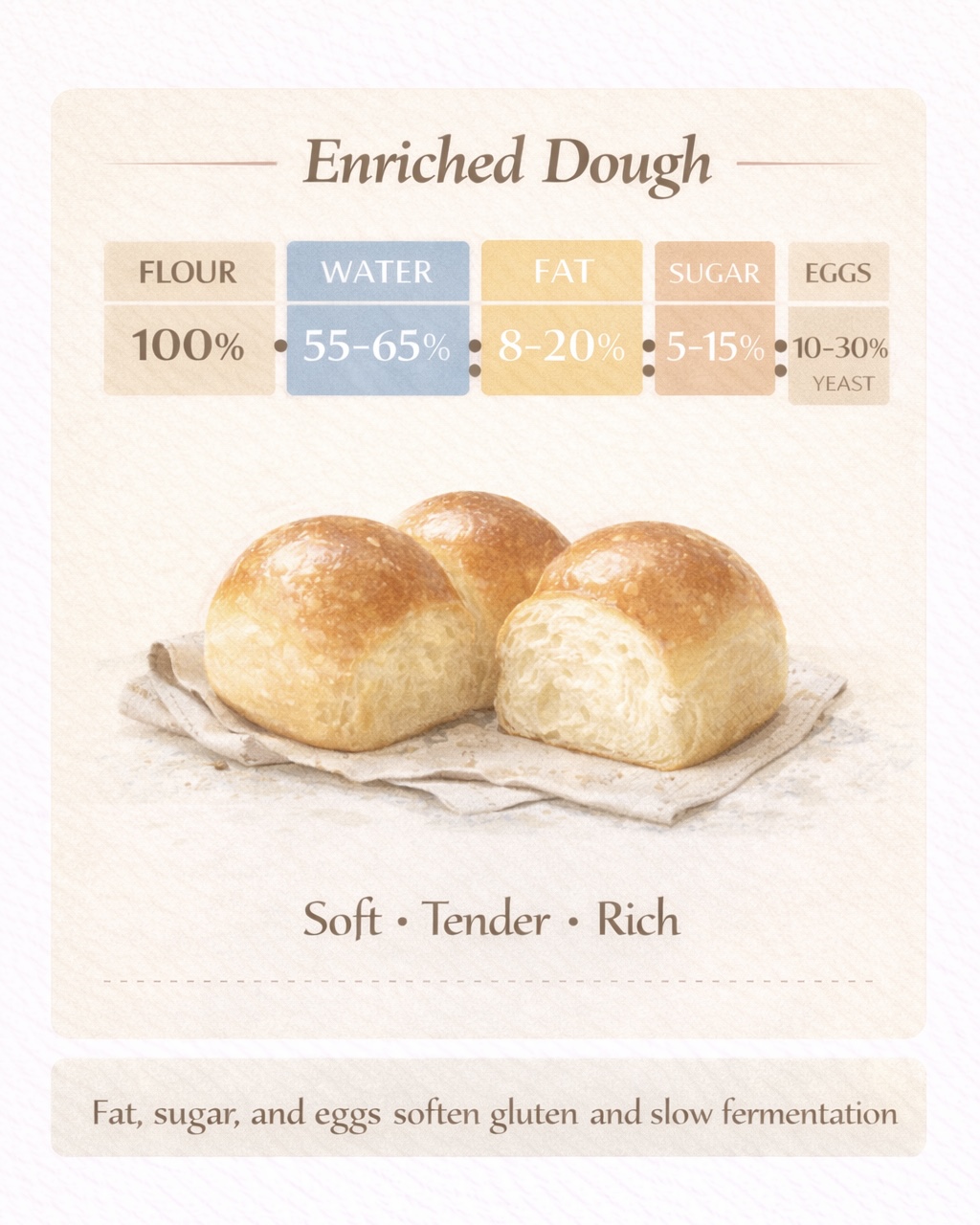
Example ratio:
- Flour : liquid = 1 : 0.55–0.65
- Plus fat, sugar, eggs
What changes here:
Fat and sugar limit gluten formation and slow yeast activity. Eggs add both structure and richness.
The result:
- Soft, tender crumb
- Rich flavor
- Slower rise
- Bread that stays soft longer
This is the difference between a crusty loaf and a cinnamon roll that’s pillowy for days.
3. High-Hydration Doughs

Ratio:
- Flour : water = 1 : 0.75–0.85
What this does structurally:
More water means:
- Looser dough
- More extensibility
- Larger air pockets
Handling is trickier, but the payoff is dramatic.
The result:
- Open, irregular crumb
- Light interior
- Crisp exterior
If bread has big holes and a custardy interior, hydration is doing the work.
The Big Takeaway
Once you understand ratios, you stop baking by fear and start baking by intention.
Instead of asking:
“Why didn’t this turn out?”
You ask:
“Which ratio created this texture?”
That’s the difference between following recipes and understanding baking—and it’s exactly how culinary school trains bakers to think.
 Brennah Van Wagoner
Weekly Newsletter Contributor since 2025
Email the author! brennah.oaks@gmail.com